 Print
What The Old Household Economy Can Teach Us About Building A More Secure Life
Your Homestead Is Too Easy To Ambush When It Has Only One Way To Make A Living
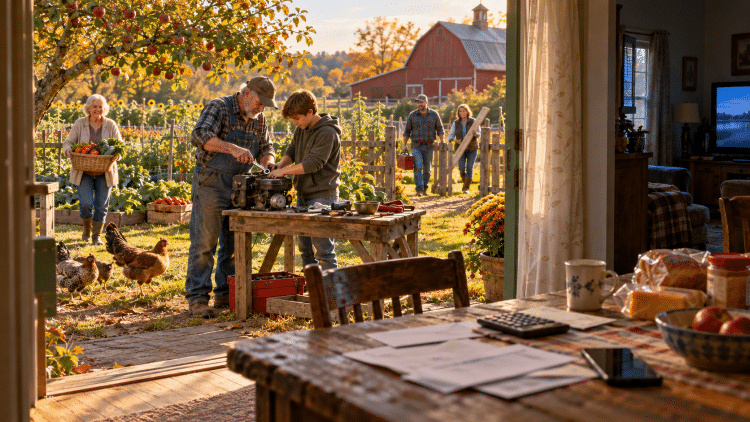
It’s the first of the month, and the kitchen table looks like a paper ambush. Truck payment. Insurance. Phone bill. Tractor loan. And that friendly little card that bought the freezer has come back asking to be fed.
Before you’ve bought a sack of chicken feed or put a gallon of diesel in the tractor, a good chunk of the month’s money has already marched out the door. You haven’t even had breakfast, and half the household income has somewhere else to be.
Now, here’s the uncomfortable part: this trap was old before anybody had a smartphone.
Even back in the 1950s, a household could have most of its income spoken for before the month got started. Installments on cars, refrigerators, television sets, and deep freezers, plus life insurance, lined up at the kitchen table before the groceries ever got there.
People called that a high standard of living. But it could be a mighty stilted one. Sure, it stood high—but picture a corncrib balanced on skinny poles with a storm rolling across the back forty.
One bad month, and the whole arrangement starts to wobble.
Ambushed is a good word for it. And if you’ve ever stared at a stack of bills while praying the transmission would last another season, you know exactly how that feels.
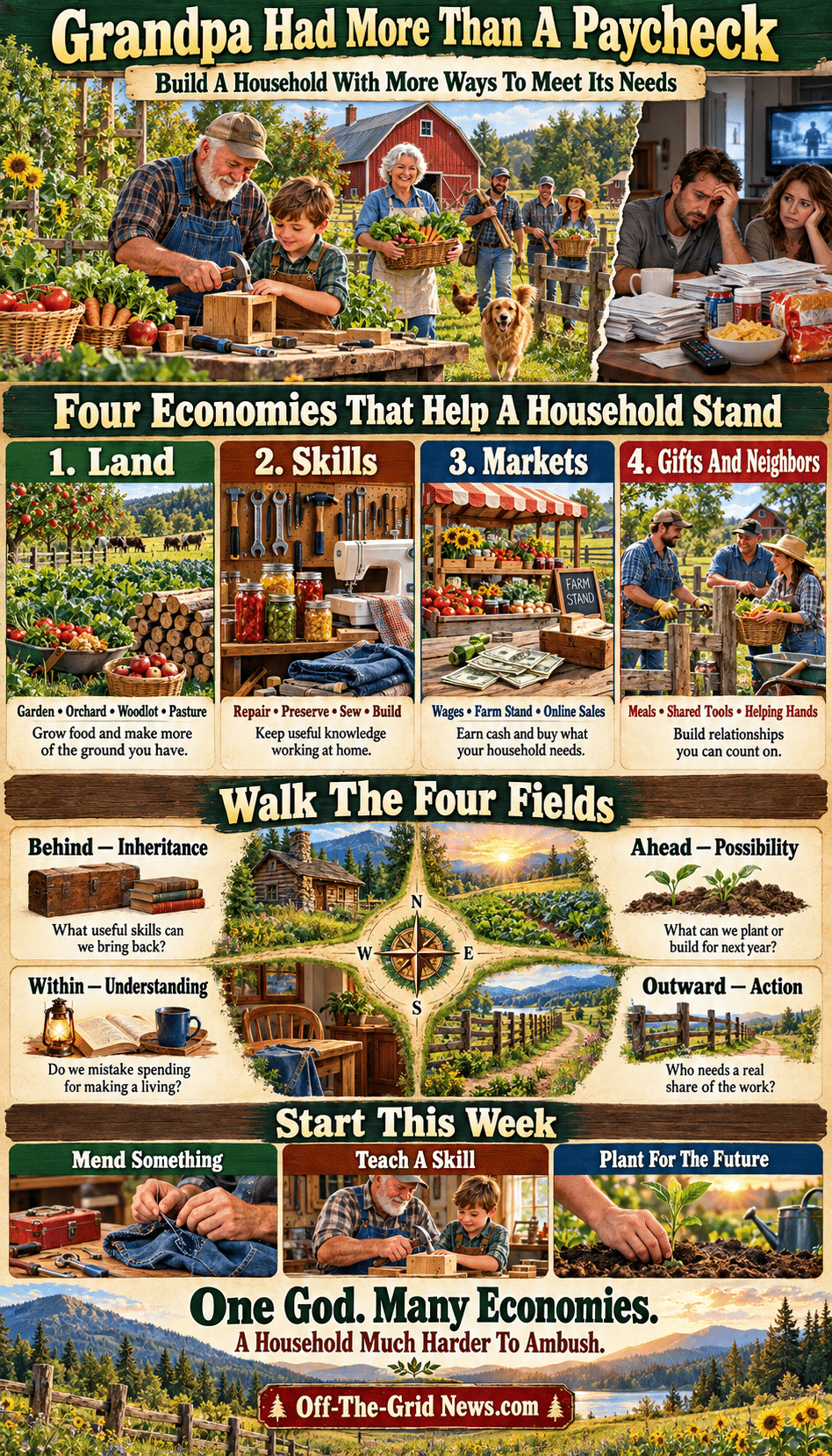
Throughout Working The Four Fields, we’ve stood in the middle of the property and looked in four directions: behind us at our inheritance, ahead at possibility, inward at understanding, and outward at action. We’ve considered borrowed time and the things a slower Saturday spent teaching can leave behind long after the day’s work is done.
This time, we’re walking the outer field with a question that reaches straight into the kitchen drawer where you keep the checkbook: How does your household make its living—and how many ways does it have to keep living when one of them quits?
Are You Planting Next Year Or Waiting For The Next Windfall
For much of human history, peace was largely the quiet stretch between two wars, financed by whatever the winners hauled home from the last one. The trouble was that yesterday’s haul could only keep tomorrow’s hunger away for so long.
When the Franks and Anglo-Saxons beat a rival king, they divided his treasure among the soldiers. Everybody lived well until the gold was spent, eaten up, or gambled away. Then somebody needed another war.
That is an economy with its eyes shut to the future. An economy worthy of the name ought to increase the peace: give people a longer quiet season and fewer reasons to depend on the next raid.
Bring that down to your county road, and you can recognize the pattern without finding a single fellow carrying a battle-axe.
One household lives from windfall to windfall. A good calf sale saves the day. Then a tax refund. Then a lucky side job. The money comes in, disappears into the same hungry holes, and everybody waits for the next rescue.
Meanwhile, another household puts something back every season. They plant fruit trees that won’t bear for years, teach a teenager to weld, and replace the rotten fence post before the cattle discover it.
The first household keeps getting through the month. The second is making the next month a little less dangerous.
That second family is building peace.
Three Ways To Put Something On The Table
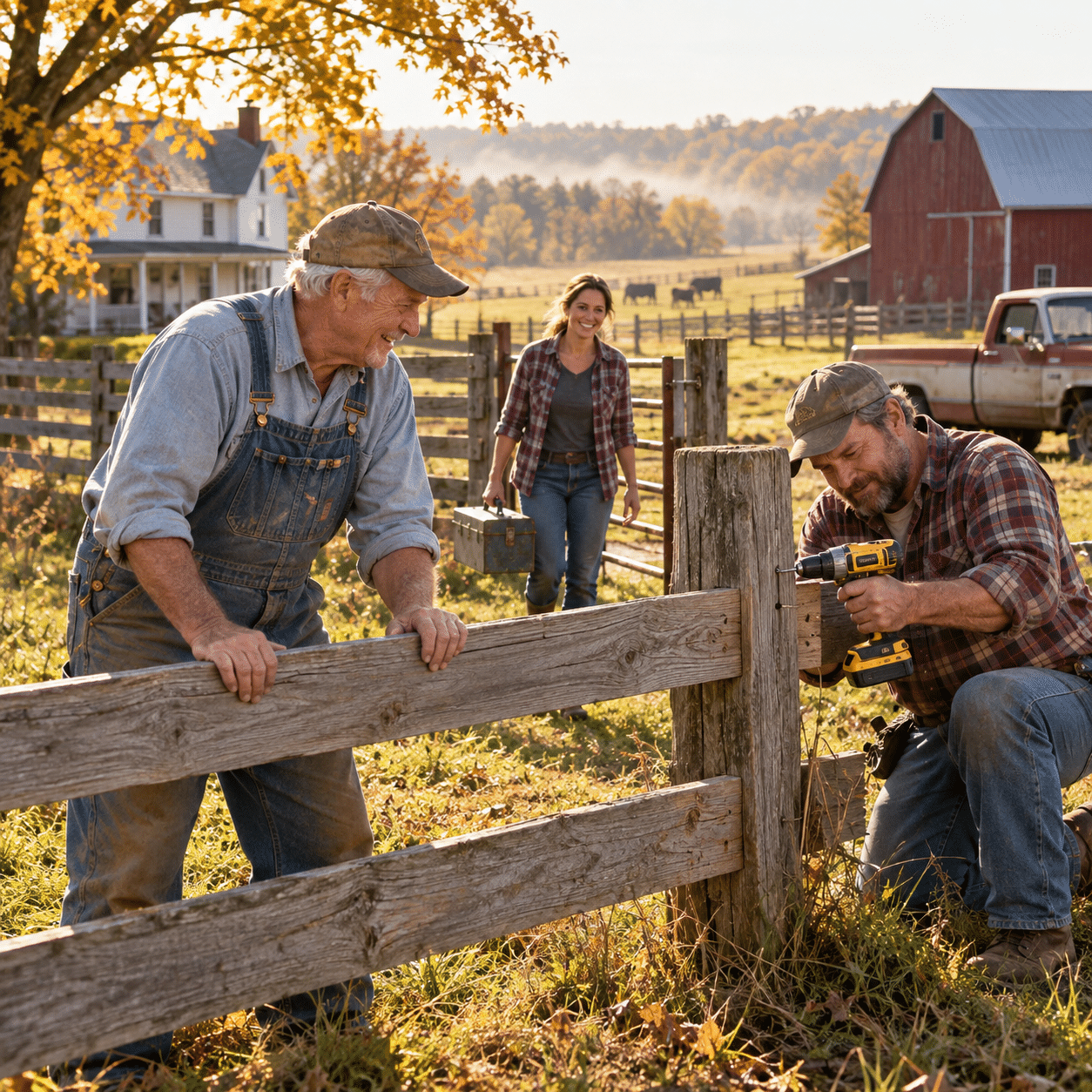
The West enlarged its margin of peace through three main kinds of economic work. Each took a leading role for centuries, and none simply vanished when the next one arrived.
First came land. Peasants and monks pushed into wilderness, cleared forest, drained marsh, and planted ground other people had passed over. More usable ground meant more room to feed a household and plan beyond the next hungry season.
American readers recognize the cleared forty, the stump pile, and the first rough furrows behind a team. On a present-day homestead, that same impulse might mean turning a weedy patch into potatoes or bringing a neglected orchard back into production. You make more of the ground you have.
Then came skill. In medieval towns, craftsmen increased wealth by getting better at their work and dividing the work more finely. Picture a goldsmith in Nuremberg waiting for a customer to order a necklace, then making it well.
He wasn’t filling a warehouse and crossing his fingers. His place in the town rested on a recognized craft, an identity that could outlast any single order. That is a different kind of footing from a job that might disappear before the week is out.
A homesteader understands this kind of wealth. It’s the neighbor who can hear what’s wrong with an engine before you’ve finished explaining it, or the woman who can look at a bushel of produce and tell you exactly what belongs in the pantry and what needs eating tonight.
Then came markets. Think of capitalism here in the particular sense of producing beyond existing orders and then going out to find buyers. Make the goods first; find the customers afterward.
Consider the old example of a Berlin firm printing inexpensive pictures of saints and selling them to Catholic peasants in Spain. Local painters made such pictures by hand, while the Berlin firm could turn out cheap prints at a tiny fraction of the cost.
At first, the profits were handsome and local craftsmen lost business. Then competitors crowded in, prices fell, and the comfortable profit margin shrank until the opportunity was largely used up.
Of course, greed wasn’t suddenly invented by a fellow with a factory. Landlords and guildsmen wanted gain, too. The difference was where they looked for it: more land, better skills, or more markets.
All three can put something on the table. Trouble starts when you expect one of them to do every job.
The Weaver Who Ended Up Selling Cameras
Consider the story of a Swedish woman who wove in an old sixteenth-century style. She came to America expecting that fine craftsmanship to support her, with years of practiced ability in her hands.
It didn’t. Unable to make her weaving pay against mass production, she went to work behind the counter of a camera shop. She had found a job, but her particular craft had no place in it.
The loss was a livelihood built around her particular craft. Her hands still knew the work; the job she found simply didn’t call upon the skill she had brought with her.
Plenty of homesteaders have watched a version of that story unfold around their own kitchen tables. Grandpa could repair nearly anything with a vise, a file, and a coffee can full of mysterious bolts. Grandma could feed twelve people from a root cellar when the roads were drifted shut.
Then, within a generation, much of that household ability got traded for a paycheck and a shopping cart. When something broke, we bought another one. When supper ran short, we drove to town.
Eventually, nobody remembered how the old job was done.
The skill didn’t disappear because it had stopped being useful. It disappeared because nobody kept practicing it… or took the time to teach it. That ought to sound familiar to anyone who has walked these Four Fields with us before.
One God Does Not Mean One Economic Recipe
Land, skill, and markets are enduring ways of making a living. They belong alongside one another, rather than being tossed onto history’s junk pile as soon as a newer arrangement comes along.
Here’s the thought worth carrying home: One God. Many economies.
The mistake is assuming that because there is one God, there must be one economic arrangement fit for every human task. That’s how people become devoted to capitalism, socialism, or communism as though their favorite system came with instructions for everything from raising children to running a power station.
The examples are wonderfully plain. You don’t need a cooperative of 10,000 members to run a flower garden, and you don’t hand a private citizen an atom bomb. Different responsibilities call for different arrangements.
A person who owns a socket wrench ought to know better than to use it for every repair.
For a homesteader, that is good news. You can earn wages, sell produce, grow your own supper, trade a useful skill, and help a neighbor… all without demanding that every activity operate by the same rules.
A land economy lives in your garden, orchard, woodlot, and pasture. It includes the eggs that go straight from the nesting box to your skillet without ever shaking hands with a cash register.
A skill economy lives in welding, canning, sewing, small-engine repair, and butchering. Some of that work serves your own place; some can be sold or traded with neighbors.
A market economy includes the farm stand, the off-farm job, online sales, and the equipment you need to buy. Cash matters. The feed store has a stubborn preference for getting paid.
Alongside those three, consider the gift economy of a living neighborhood: meals carried to a sick family, a borrowed trailer, and the people who show up when your barn needs a roof. You don’t invoice every kindness, but those relationships help keep a household standing.
The point is to have several ways of meeting real needs. A paycheck buys groceries; a garden supplies some of them; a repair skill keeps money from leaving; a trusted neighbor may help when money can’t solve the immediate problem.
Bolivia’s historic dependence on tin offers a picture of the trouble that follows when a country leans too heavily on one product and its changing world market. When that one market shakes, the whole country feels the floor move.
Don’t let your homestead become the Bolivia of your county road.
The Last Market Was Sitting In Your Kitchen
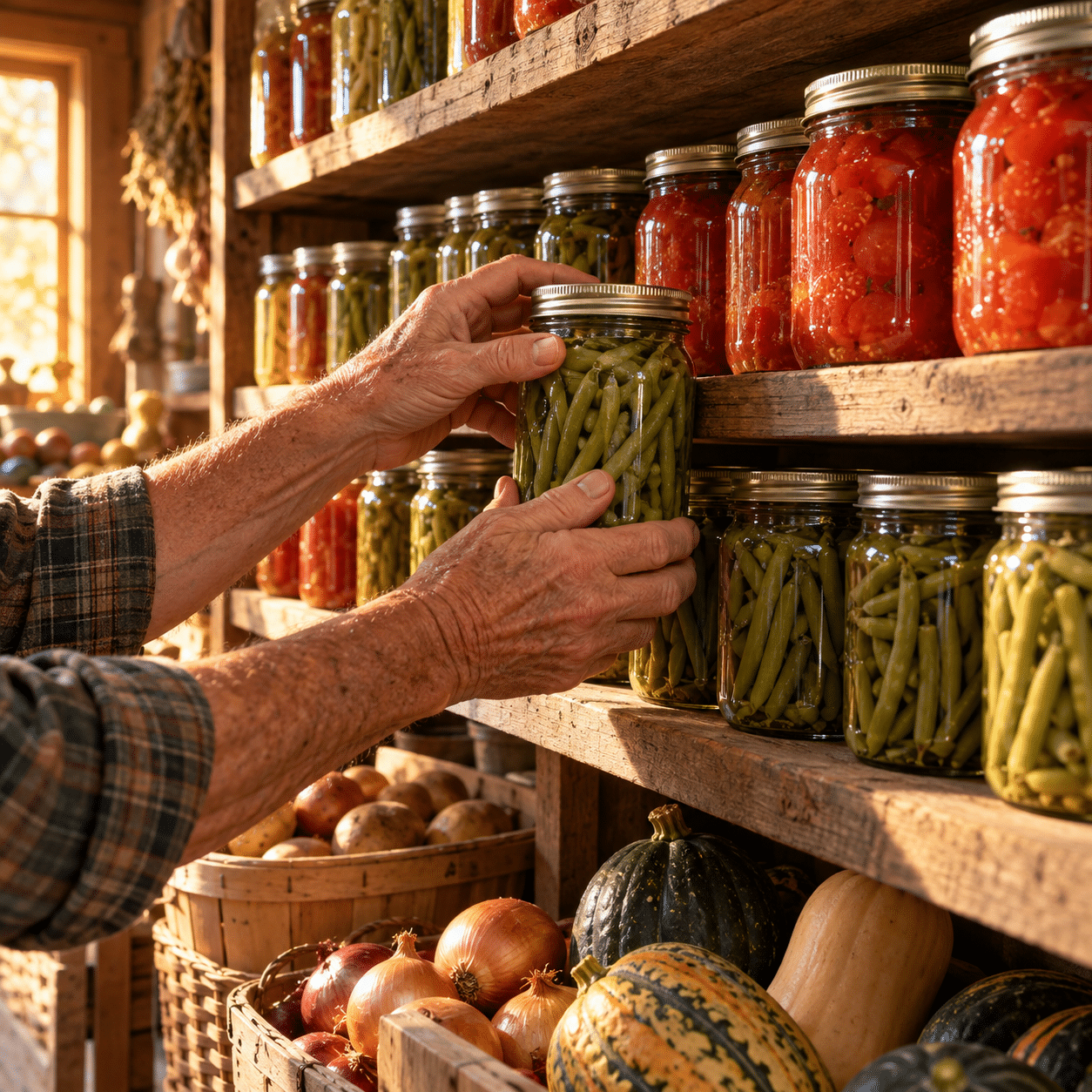
Now consider something that lands like a dropped skillet. One of the last great markets mass production moved into was the home itself: the kitchen, pantry, cellar, and all the ordinary work households once did for themselves.
As long as people made lace and mended socks, there was still household work a manufacturer could try to replace with something for sale. Eventually, the habit changed. Now the sock gets a hole, and out it goes.
Think about that. Every task moved out of the household created another thing the household had to buy. Food preparation, clothing repair, storage, maintenance—one by one, useful abilities could be replaced with purchases.
And how much do we mend today? Too often, we throw the thing away and head for the store.
That same throwaway habit was already taking hold generations ago. Take a look at the dump now.
That’s why putting up tomatoes, darning a sock, or sharpening your own chainsaw has a place in a serious discussion of household economics. Each job keeps some useful work at home and gives you another way to meet a need.
A jar of beans doesn’t send a monthly bill. A skill you’ve practiced doesn’t require a delivery truck before you can use it.
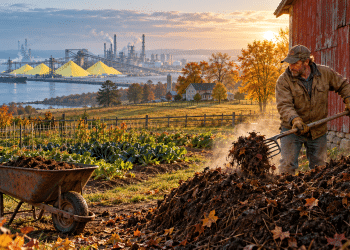
And the more ordinary needs you can meet with the ground, tools, and knowledge already at hand, the less of your life has to wait for the next deposit. That is one practical way to loosen the ambush.
Give Everybody At The Table A Real Piece Of The Work
Here’s a question that deserves more room in our economic thinking: How does a society give every person a real place in its work? Unemployment can become a kind of war inside a community, leaving people stranded while useful work waits to be done.
The challenge is to help a person without work become a contributor whose abilities have somewhere to go. In household terms, that means finding a place where somebody’s effort is needed and their contribution matters.
So look around your table. Who has been left without real work?
Maybe it’s the twelve-year-old with a phone, two good hands, and nothing anybody trusts him to fix. Maybe it’s the retired father who moved in and now watches the driveway because nobody thought to ask him about sharpening the hoes or sorting next spring’s seed.
Or maybe it’s you. You work all week at a job that pays the bills, then come home too worn out to build much of anything on your own place.
A homestead offers a useful opening here. There is food to grow and store, equipment to maintain, and knowledge that needs another pair of hands to keep it alive. Give somebody a real responsibility suited to their ability, along with the teaching and tools to carry it.
A teenager tending the chickens has a job the family can see at breakfast. An elder guiding seed saving has a say in next year’s garden. Both have a share in the household’s future.
And now the outer field connects with the other three. Inherited knowledge becomes present work; understanding guides it; and somebody younger gains an ability they can carry forward.
Walk The Four Fields Before The Bills Come Due
Before the next stack of envelopes lands on the kitchen table, take another walk around the place. Bring a pencil if it helps, and give each field an honest look.
Look behind, into the field of inheritance. What did the people before you know how to do that your household has let slip? Pick one useful skill worth bringing back, then find someone who can teach it while there’s still time to ask.
Look ahead, into the field of possibility. What could you add this year that would give your household another way to meet its needs? Maybe it’s a few fruit trees, a repair trade, a small product people want, or a stronger trading relationship with the neighbor down the road.
Look inward, into the field of understanding. Have you started believing that making a living means only collecting money and spending it? Look carefully at the work already feeding you, saving you expense, and holding your household together.
Then look outward, into the field of action. Who at your table or along your road needs useful work, and what responsibility could you help them take on? What can you actually begin this week?
Start small enough to finish. Mend the thing you were going to throw away, ask Grandpa to show the youngster how that tool works, or plant something whose best season is still years ahead.
Then keep at it. Let this year’s work leave next year’s household a little stronger, with more ability on hand and fewer needs waiting helplessly for payday.
One God. Many economies. A household with several ways to live.
That’s a household much harder to ambush.