 Print
Print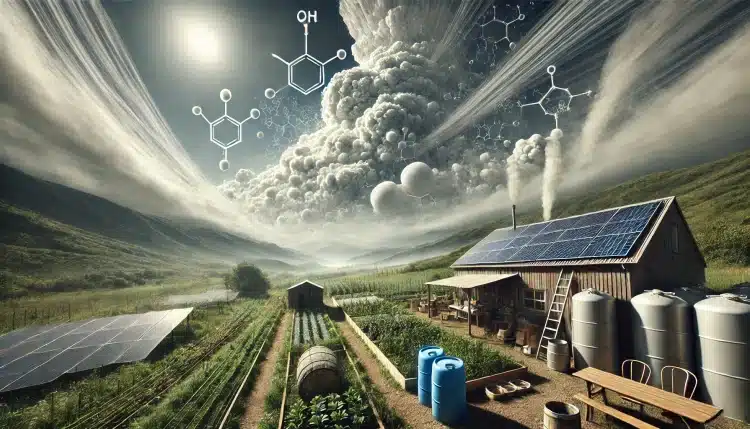
The Hidden Battle for the Clouds
Step outside on a clear day and tilt your head back. Instead of that deep, endless blue many of us grew up with, the sky now carries a strange, smeared-over look—like someone dragged a dirty paintbrush from horizon to horizon.
Long white lines stretch across the heavens, not briefly, not innocently, but in slow-motion. They linger, they widen, they feather out into a chalky haze that dims the sun and hangs over towns like a translucent lid. Meanwhile, the air no longer snaps with that crisp, clean feel like it did when we were kids. Nope. On many days, it sits heavy in your chest, like you’re breathing through an old furnace filter overdue for replacement.
Those aren’t the quick contrails from childhood, the kind that vanished in moments. These lines expand, descend, and settle—into your soil, your water, your garden beds, and ultimately your bloodstream. Yet while this quiet fallout unfolds above our heads, the media still frames climate engineering as some “future concept,” a sci-fi solution a few dreamers might one day attempt. We’re told it’s normal exhaust, normal condensation, just another day in the sky.
But the sky disagrees. And if you live off-grid—or you’re inching your way there—what happens above you isn’t abstract. That sky is your roof, your water source, your solar harvest, your growing season, and heck, your survival.
Not Climate Change—Climate Collapse

Now, everywhere you turn, you hear the same sanitized B.S. phrase: climate change. As if this is some gentle, slow-moving shift we can correct with a couple policies and a new gadget or two. But let’s be brutally honest: what’s hitting us isn’t “change.” It’s collapse—abrupt, violent, accelerating.
For decades, methane has been erupting from thawing permafrost like a busted gas line, creating a planet-sized greenhouse lid. Meanwhile, ocean acidification is speeding toward thresholds that threaten not just coastal economies but the entire marine food chain. Yet through all this, climate-engineering programs keep spraying nanoparticle metals and polymers into the upper atmosphere, supposedly to reflect sunlight.
Except they don’t just reflect. They trap heat long-term, they disrupt hydrological cycles, and they create short, violent weather whiplash events that leave ordinary people confused enough to accept the official story. The public sees chaos. But chaos can be manufactured.
Weather Whiplash and Scripted Storms
All around the globe, weather now feels… scripted. One day you’re baking under record heat. The next, an “Arctic blast” drops hail the size of softballs and leaves your homestead looking like January in Minnesota—even if you live far from snow country. The news will confidently chalk it up to a “quirky stratospheric warming event” or a playful La Niña–meets–polar vortex tango. Cute explanation. Convenient timing.
But behind the curtain? Weather systems are being nudged, steered, and sculpted using ionospheric heaters, aerosol layers, and chemical ice nucleation technologies. Flood Gaza to the point where tents wash away. Drag Iran through decade-long droughts so severe officials quietly discuss evacuating entire cities. When you can supercharge moisture, redirect pressure zones, and lock cold air masses in place, you can deliver both flood and famine like items on a menu.
This isn’t random. It’s engineered volatility.
Microplastics, Nanopolymers, and Every Breath You Take
And while the sky churns unnaturally, something else is happening inside us.
Recent studies warn that everyday microplastics—just the visible stuff—can inflame arterial cells, drive atherosclerosis, and elevate heart attack and stroke risk, especially in men. That’s the part researchers can measure in tap water and food packaging. But what about the nanoplastics and nanopolymers too small for modern tools? Those pass through tissue barriers like ghosts. They embed in organs. They lodge deep.
Now add to that the aerosol fallout from climate manipulation: fine metals, synthetic fibers, engineered particles. These descend invisibly, invisibly accumulate, and invisibly alter everything from soil microbes to human blood. And here’s the kicker—there’s no known way to purge this cocktail from the human body. Some great natural detox possibilities, sure. But no ultimate detox protocol for what’s going on above. No filtration system. It builds, quietly, day after day.
The damage is cumulative. And it doesn’t discriminate.
The Grid, the Nukes, and the AI Hunger
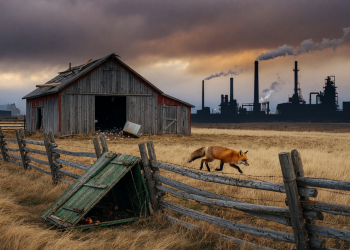
Meanwhile, the biosphere buckles under the weight of industrial excess, but the official solution isn’t restraint. It’s escalation, pure and simple. “Dirty energy” is being “restarted” and rebranded as green energy hubs—not because local families need electricity, but because artificial intelligence data centers do.
Yep, AI is the new golden calf. More servers. More cooling. More power. More extraction. And while the grid frays, policymakers rush to bolt on bigger, more centralized systems that depend on perpetual growth—growth that devours landscapes, water, minerals, and maybe our sanity.
Anyone trying to go off-grid should see this as a flashing red warning. The system isn’t just unstable. It’s being overloaded by design.
Food, Water, and a Failing Web of Life
While all this high-tech turbulence unfolds in the sky and on the grid, the basics of life quietly slip through our hands.
Reservoirs shrink to record lows. Cricks dry up. Aquifers vanish under thirsty cities. Some places get mere days of meaningful water left before taps run dry. Elsewhere, sudden engineered deluges wipe out entire crop cycles.
Rice harvests crash under brutal swings between drought and flood. Oyster beds and fish farms see mass die-offs as waters warm, acidify, and fill with toxins. Even wild-caught fish now carry a chemical burden. Even weirder, farmed fish might be the most toxic protein on modern plates. And the oceans—dump sites for radiation, plastics, and industrial solvents—are losing their ability to support life.
At the same time, the atmosphere becomes a laboratory for experimental particulates.
This is what ecological collapse looks like mid-stride.
Deception, Distraction, and Manufactured Perception
And through it all, those in power rely on their most reliable tool: perception management. That’s their term—not ours.
As long as the public is hypnotized by political theater, celebrity feuds, professional sports, and carefully curated news cycles, they’re not looking up. They’re not asking why the clouds look digitized, why the leaves on trees look chemically singed, or why seasons no longer run in recognizable patterns.
This is where Stockholm Syndrome scales up to whole societies. People begin defending the same institutions that are suffocating them. They lash out at anyone who points at the bars of the cage. They cling to the fantasy that “their” political side will magically fix weather warfare, dismantle the surveillance grid, and restore the planet’s life-support systems.
But administrations change. Parties flip. And the jets don’t stop.
Off-Grid Eyes Wide Open
So what does all this mean for the off-grid community? For the growers, the homesteaders, the rainwater collectors, the people trying to build something sane?
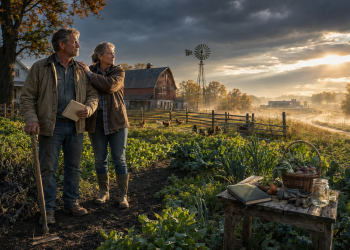
First, it means this: going off-grid isn’t just about putting up panels and planting raised beds. It’s about awareness. It’s about recognizing that the sky itself is contested space. It’s about understanding that your homestead is a micro-fortress of resilience in a destabilized world.
Practically, that means guarding your water like gold—filtering, distilling, testing, and never assuming that what falls from the clouds is clean. It means rebuilding soil life with compost, biology, trace minerals, and cover crops so the land can buffer at least some fallout. It means designing energy, food, and shelter systems that can withstand weird weather, rolling blackouts, grid sabotage, and sudden shortages.
It means seeing clearly, not sleepwalking.
Urgent: Refuse to Go Quietly
We need to wake up. After all, real hope doesn’t come from pretending we’re safe. It comes from grit. From stubbornness. From choosing, deliberately, not to go quietly into the collapsing night.
Hope is the decision to keep preparing your land when the sky looks wrong. Hope is refusing to swallow the official line. Hope is linking arms with neighbors, swapping seeds, sharing knowledge, and building the local, living networks that centralized power fears most.
No one can steal that resolve. No corporation, no agency, no algorithm can confiscate your will to resist, to guard the people you love, and to keep speaking truth even when the world calls you crazy.
So keep your eyes on the sky. Keep your boots on the ground. Keep building your off-grid lifeboat plank by plank.
And above all—keep pushing truth into the open. Because if enough of us refuse to bow, refuse to be quiet, and refuse to stop. And pray… with God, all things are possible. Don’t think we’re beat. It’s never over till you’re six feet under.