Print
The Forgotten Story Behind One of America’s Most Useful Backyard Plants
Why the Weed Most Homesteaders Keep Mowing Down Has Been Offering Free Medicine Since Long Before the First Covered Wagon Rolled West
Walk out to your gravel driveway before breakfast tomorrow morning.
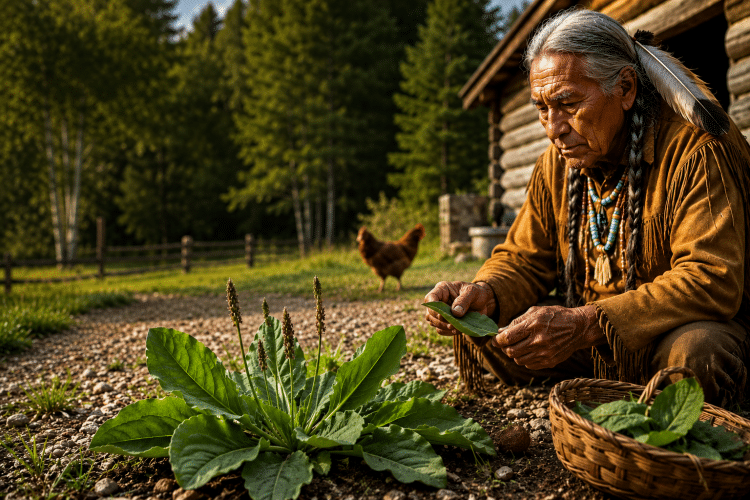
Wander down the worn path leading to the chicken coop, the woodshed, or the old barn, and keep your eyes on the ground instead of the horizon. Chances are, you’ll spot a humble little plant spreading its broad green leaves flat against the earth, growing exactly where boots, wagon wheels, livestock, and tractor tires have packed the soil hard over the years.
Most folks never give it a second glance. They mow it, spray it, or yank it out by the roots without ever wondering why it insists on growing in the same places year after year.
That little “weed” has a remarkable story to tell.
Long before the first settlers built log cabins, fenced pastures, or planted cornfields across North America, Native American tribes had already learned to recognize this rugged little plant as something special. They watched it appear wherever Europeans settled, and they gave it a name that has survived for centuries.
“White man’s foot.”
It’s one of the most colorful names ever given to a plant, and once you understand where it came from, you’ll never look at the weed growing beside your barn quite the same way again.
The Plant That Seemed to Follow the Settlers

When European settlers crossed the Atlantic, they weren’t traveling alone. Along with livestock, grain, clothing, tools, and household goods came thousands of tiny hitchhikers that no one noticed. Seeds clung to muddy boots, lodged in wagon wheels, hid in animal feed, and worked their way into blankets, hay, and supplies.
As settlements pushed farther inland, something curious happened. Native tribes began noticing a new plant springing up wherever the newcomers established homes, trading posts, military forts, or wagon camps.
The pattern repeated itself again and again.
Places that had never seen this broad-leafed plant suddenly found it growing along trails, around cabins, beside roads, and anywhere the settlers disturbed the soil. To people who lived close enough to the land to notice even subtle changes in the landscape, the connection became impossible to ignore.
So they gave the plant a simple, descriptive name.
“White man’s foot.”
The nickname wasn’t born out of folklore or fantasy. It reflected careful observation. The plant seemed to arrive wherever European feet had walked, almost as though it were following the newcomers across the continent one muddy boot at a time.
Today botanists know the plant as broadleaf plantain (Plantago major). Ironically, while European settlers accidentally scattered its seeds across North America, many of them overlooked the remarkable value growing right beneath their own feet.
The Native people didn’t.
The Original Classroom Was the Land
Long before there were universities, laboratories, or scientific journals, there was the forest.
There was the prairie.
There was the creek bank.
For countless generations, Native American families learned by paying attention to the world God had placed around them. Every season taught new lessons. Every hunt, every harvest, every changing weather pattern added another page to an unwritten book that could only be read by careful observers.
That kind of knowledge wasn’t built in a weekend.
It took centuries.
People discovered which berries nourished and which poisoned. They learned which tree bark made useful cordage, which roots eased stomach troubles, and which leaves soothed burns, insect bites, or cuts. The land became both pantry and pharmacy because survival depended upon understanding what creation was quietly offering.
That’s a lesson modern homesteaders understand better than most.
Spend enough years raising gardens, tending livestock, cutting firewood, and watching the seasons roll by, and you begin seeing patterns that no instruction manual can teach. You notice where the deer cross the fence every autumn. You learn which fruit trees bloom first after a mild winter and which corners of the pasture always stay wet after a heavy rain.
The land rewards people who pay attention.
That’s exactly what Native Americans were doing when they first noticed broadleaf plantain following the settlers across North America. While others might have dismissed it as just another unfamiliar weed, they watched it closely, studied where it grew, and eventually discovered it was far more useful than it first appeared.
The Weed That Refused to Quit
If you’ve ever tried pulling plantain out of your driveway, you already know one thing about it.
It doesn’t give up easily.
Its broad leaves spread low across the ground like a green wagon wheel, avoiding mower blades and grazing animals alike. Beneath the surface, a tough network of roots anchors it firmly into compacted soil where many other plants simply refuse to grow.
That’s one reason you’ll often find it exactly where life is hardest.
Along gravel drives.
Beside old barn foundations.
In livestock pens.
On heavily traveled footpaths.
Even in the cracks where hard-packed earth seems almost incapable of supporting life.
Most gardeners see those places as problem areas. Plantain sees them as opportunity.
In many ways, it’s the perfect homesteader’s plant. It doesn’t demand rich soil, daily watering, or special treatment. It quietly survives drought, foot traffic, changing weather, and neglect, returning year after year without asking for a thing.
Perhaps that’s why so many people overlook it.
We’re naturally drawn to the spectacular.
Bright flowers catch our eye.
Perfect tomatoes earn our admiration.
Rare herbs with exotic names fill expensive catalogs.
Meanwhile, one of the toughest and most useful plants on the property quietly goes about its business beneath our boots, asking for nothing more than a little attention.
A Frontier First-Aid Kit Growing in Plain Sight
Life on the frontier had a way of making small injuries seem much bigger.
A scraped shin while splitting firewood could turn serious if infection set in. A bee sting during the summer honey flow could swell enough to end a day’s work. Blisters, splinters, burns from the cookstove, cuts from an axe, or rope burns from handling livestock were simply part of everyday life.
People couldn’t drive to the nearest pharmacy.
They had to use what the land provided.
Native American healers were among those who recognized that fresh plantain leaves could be crushed into a moist poultice and laid directly over cuts, scrapes, insect bites, minor burns, and irritated skin. The cool leaves were valued for their soothing qualities, and generations of experience taught them that this common trail-side plant often earned a permanent place among the useful herbs they gathered throughout the year.
European settlers eventually began learning many of those same lessons.
As families adapted to frontier life, practical knowledge often traveled from neighbor to neighbor regardless of where it originated. Over time, plantain found its way into countless homestead traditions, becoming one of those dependable plants that people reached for because experience had taught them it was worth keeping around.
There was nothing glamorous about it.
It simply worked often enough to earn people’s trust.
And out on the frontier, that was recommendation enough.
When Modern Science Finally Catches Up
One of the most interesting things about studying traditional herbal remedies is how often modern researchers end up investigating plants that ordinary people had already been using for generations. Scientists don’t always confirm every historical claim, but time and again they discover that many of those old remedies contained naturally occurring compounds worthy of closer examination.
Broadleaf plantain is one of those plants.
Researchers have identified a number of naturally occurring compounds inside its leaves, including allantoin, aucubin, flavonoids, tannins, mucilage, and several antioxidant compounds. These substances have attracted scientific interest because of their potential roles in supporting healthy skin, calming irritation, and assisting the body’s normal tissue-repair processes.
That doesn’t mean every traditional use has been proven by large clinical trials.
It does mean the little weed beside your driveway has turned out to be far more chemically complex than anyone once imagined. In many ways, modern laboratories are simply asking questions that observant people living close to the land began asking hundreds of years ago.
That’s a humbling thought.
Sometimes the newest discoveries begin with the oldest observations.
A Plant That Never Asked for Attention
One reason plantain has survived for so many centuries is that it doesn’t compete the way most plants do. It doesn’t tower over the grass or produce brilliant flowers that draw your eye from across the pasture. Instead, it quietly goes about its business, hugging the ground and thriving where life is hardest.
There’s something almost symbolic about that.
Our culture has trained us to chase whatever is newest, brightest, or most expensive. We assume the greatest value must come from the rarest supplement, the imported superfood, or the latest miracle ingredient advertised across television screens and social media.
Yet God’s creation often works differently.
Some of His greatest gifts hide in ordinary places, waiting for someone curious enough to stop and look more closely.
Plantain is a perfect example.
It has no flashy blooms.
No exotic name.
No glossy marketing campaign.
Just quiet usefulness.
Homesteaders have always understood that principle. The best fence post isn’t necessarily the prettiest one. The most dependable tractor isn’t always the newest. Likewise, the best laying hen is usually the one that keeps producing eggs day after day without demanding constant attention.
Reliability has its own kind of beauty.
Learning to See Like the Old-Timers
One of the greatest skills a homesteader can develop has nothing to do with buying better equipment or owning more land.
It’s learning to notice.
Notice the weather before it changes.
Notice when the hens begin acting differently.
Notice which apple tree blossoms first each spring.
Notice where the deer cross the fence line every evening.
The land is constantly giving clues to people willing to slow down long enough to see them.
Native Americans became extraordinary observers because their lives depended upon it. Every season taught another lesson. Every creek, meadow, woodland, and prairie revealed patterns that were easy to miss unless you spent years paying attention.
Homesteaders live much the same way.
The longer you work a piece of ground, the more familiar it becomes. You begin recognizing which weeds indicate compacted soil, which wildflowers attract pollinators, and which volunteer plants return year after year for reasons that aren’t accidental.
The land becomes a teacher.
That’s one reason stories like “white man’s foot” still matter today. They’re reminders that careful observation often uncovers treasures hidden in plain sight.
Not Every Weed Is Your Enemy
Walk through any home improvement store, and you’ll find entire aisles devoted to killing weeds. Every bottle promises cleaner lawns, tidier driveways, and perfect landscapes free from unwanted plants.
Sometimes those products have their place.
But they can also encourage us to see every volunteer plant as an enemy before we’ve even learned its name.
Nature is rarely that simple.
Many so-called weeds are pioneer species that move into damaged ground long before other plants can survive there. Some loosen compacted soil with deep roots. Others feed bees and butterflies when little else is blooming. Still others provide food for birds, wildlife, or livestock, while a surprising number have long histories of medicinal or culinary use.
Plantain belongs in that last group.
It reminds us that usefulness isn’t always measured by appearance. Sometimes the plainest plants turn out to have the richest stories, and the greatest value often hides beneath ordinary leaves growing where nobody thinks to look.
Stewardship Begins with Curiosity
One of the quiet tragedies of modern life is how quickly we’ve lost the habit of asking simple questions.
“What is this plant?”
“Why is it growing here?”
“What purpose might it serve?”
Instead, we often assume that if we didn’t intentionally plant it, it probably doesn’t belong.
Previous generations thought differently.
Whether they were Native Americans learning the rhythms of creation, frontier families carving farms out of the wilderness, or grandparents tending kitchen gardens through hard times, they developed a habit of paying attention before taking action. They knew every plant had a story, even if that story wasn’t immediately obvious.
That’s still good advice today.
Curiosity is often the first step toward stewardship.
When we slow down long enough to learn the names, habits, and purposes of the plants around us, we begin seeing the property differently. The homestead stops being just land we own and becomes creation we’ve been entrusted to understand.
That’s a very different way of looking at the world.
The Wisdom Beneath Your Boots
There’s something wonderfully ironic about the story of “white man’s foot.”
European settlers unknowingly carried the seeds across an ocean. Native Americans noticed the pattern almost immediately and gave the plant a memorable name. Then, for generations afterward, countless people walked past the very weed their neighbors had learned to value without ever realizing what was growing beneath their own feet.
That story isn’t really about a weed.
It’s about paying attention.
The people who know the land best are rarely the ones with the most expensive equipment or the biggest libraries. More often, they’re the ones who spend enough quiet mornings outdoors to recognize small changes, subtle patterns, and overlooked gifts that everyone else hurries past.
That’s how wisdom grows.
Not all at once.
One season at a time.
One careful observation after another.
A Lesson Every Homesteader Can Carry
The next time you’re walking to the barn, feeding the chickens, or checking the garden after a summer rain, take a moment before firing up the mower or reaching for the weed sprayer. Kneel down beside that broad-leafed plant growing along the path and really look at it.
Notice its thick leaves.
Notice its strong veins.
Notice where it chose to grow.
Then remember the Native elder who watched this same little plant appear wherever settlers traveled and quietly gave it a name that history still remembers.
“White man’s foot.”
That wasn’t just colorful folklore.
It was the conclusion of people who knew how to read the land.
Perhaps that’s the greatest lesson broadleaf plantain still has to teach us. God’s creation is filled with quiet provisions that reveal themselves only to people willing to slow down, observe carefully, and remain humble enough to admit the ground beneath their boots may still have something left to teach them.
And for a homesteader…
That’s a lesson worth carrying down every trail.