 Print
Print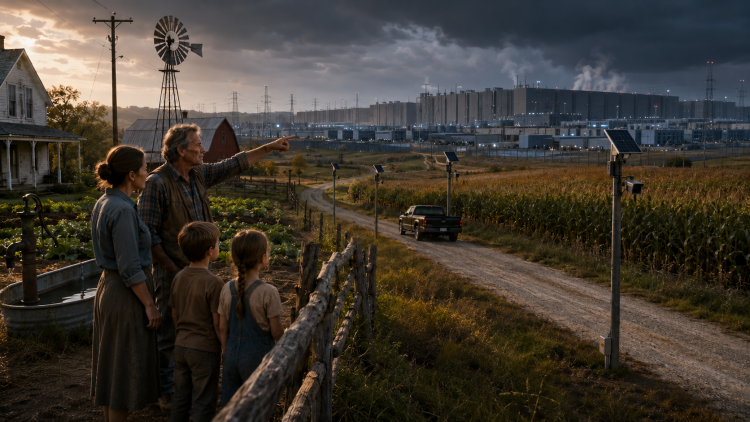
The Question Silicon Valley Billionaires Hope Rural America Never Asks
Behind America’s New Windowless “AI Factories” Is a Growing System Built to Collect, Store, and Search Nearly Everything You Do
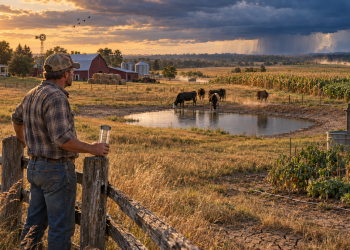
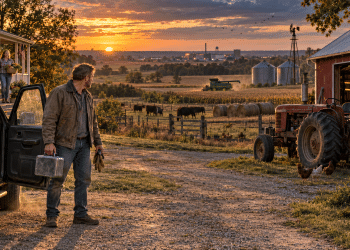
When you live out in the country, you learn to pay attention when something much bigger than you wants to move into the neighborhood.
First, the survey stakes appear. Then a new fence line cuts across an old field. Heavy trucks begin rolling down roads that were quiet a month ago. Before long, the well starts acting funny, the lights flicker during supper, and strangers in clean boots begin asking questions they don’t seem willing to answer themselves.
That’s what’s happening across rural America right now.
Only this newcomer isn’t a feedlot, factory, or shopping center. It’s a sprawling, windowless concrete compound surrounded by fences, cooling equipment, power lines, cameras, and security gates. Some of these so-called “hyperscale” data centers are big enough to swallow hundreds of acres.
We’ve all heard the official sales pitch. Washington and Silicon Valley say America is locked in an artificial intelligence race with China, and we have to win—whatever it costs. That’s why billions of dollars are pouring into new data centers from Tennessee to Michigan and nearly everywhere in between.
According to the people building them, it’s all about innovation, national security, and keeping America at the front of the technological pack.
But follow the money, the contracts, and the surveillance systems already appearing along our roads, and another picture starts to emerge.
Investigative journalist Derrick Broze, founder of The Conscious Resistance Network, has been examining the data center boom while traveling the country on his Activation Tour. His warning is blunt:
These facilities aren’t being built merely so Americans can ask chatbots for recipes or have artificial intelligence polish an email.
They’re being built to hold data.
Your data.
This Is Bigger Than a Better Computer

Sure, plenty of ordinary folks have used ChatGPT, Grok, or another AI program. Maybe you’ve asked one to explain a repair job, outline a garden plan, or help write a letter.
But that kind of everyday use doesn’t fully explain why corporations are racing to build thousands of enormous facilities that consume staggering amounts of land, electricity, and water.
The United States already has far more data centers than any other country. Still, the construction boom keeps accelerating. New campuses are being announced at a pace that makes it feel as though every available cornfield near a transmission line has suddenly been marked for concrete.
So what are all those servers going to do?
The answer may begin with something most Americans already carry in their pocket: a digital trail.
Every card swipe, online search, license-plate scan, facial image, location signal, medical record, social-media post, and government form creates another scrap of information. One scrap may not reveal much. Gather millions of them together, however, and they can paint a remarkably detailed picture of a person’s habits, relationships, movements, beliefs, and weaknesses.
That mountain of information has to live somewhere.
Every Camera Creates Another Piece of the Puzzle
Look at what has quietly appeared along America’s roads. Flock Safety cameras and automated license-plate readers now watch vehicles pass through neighborhoods, subdivisions, shopping centers, gas stations, and rural intersections.
Meanwhile, facial-recognition systems are slipping into airports, stores, schools, workplaces, and public spaces where nobody would have expected them a few years ago. Smartphones continuously generate location information, while smart doorbells, connected vehicles, and household devices add still more eyes and ears to the network.
One camera may seem harmless. One license-plate reader may be explained as a tool for catching car thieves.
But when those separate streams are gathered together, stored for long periods, and searched by artificial intelligence, they become something far more powerful. AI can sift through billions of records faster than an army of human analysts, spotting connections that would have once remained buried.
That’s where companies such as Google, Amazon, Meta, Microsoft, Oracle, and Palantir enter the picture. These companies don’t merely sell software or rent space on a server. They build the digital barns where all this information can be stacked, sorted, analyzed, and retrieved.
And unlike the old hay barn, this one never forgets what was put inside.
When the Machine Starts Looking for “Extremists”
Broze warns that the real danger arrives when AI is turned loose on this growing ocean of information and told to identify threats, suspicious patterns, or potential “extremists.”
That word should make every American sit up a little straighter.
Labels have a way of stretching. Today, an extremist may be someone planning violence. Tomorrow, it could be a farmer protesting a land seizure, a mother challenging a school board, or a citizen asking too many questions at a county meeting.
Once an automated system begins assigning risk scores, flagging associations, or building profiles, ordinary people may never know why their names ended up on a list. They may not even know the list exists.
There may be no accusation to answer, no witness to question, and no courthouse where the machine can be cross-examined.
Just a silent judgment buried inside a server farm.
Your Land, Your Water, Their Machines
Anyone who has raised livestock, hauled water, or tried to keep a garden alive through a dry July understands that electricity and water aren’t abstract resources.
You can see the water line dropping in the well. You can hear a pump straining. You know what happens when the power goes out during a cold snap or the rain refuses to fall for six straight weeks.
Hyperscale data centers operate on an entirely different level. Depending on their design and cooling systems, large facilities can require enormous amounts of water and enough electricity to rival the needs of a city.
Now imagine dropping that demand onto a rural power grid already groaning under summer air-conditioning loads, winter storms, and years of neglected infrastructure.
The company gets its power contract. The company gets its water allocation. Meanwhile, families down the road wonder why their electric bills keep climbing and why their wells no longer recover the way they once did.
Then there’s the noise.
Cooling fans, backup generators, electrical equipment, and round-the-clock industrial operations don’t go quiet when the sun slips behind the barn. That low mechanical hum can carry across fields and fence lines, settling over nearby homes day and night.
Industrial noise doesn’t stop at the property line.
Neither does a drained aquifer.
The Deal May Be Signed Before You Hear About It
Naturally, neighbors start asking questions when a project like this is proposed.
How much water will it use? Who pays for the new power lines? Will homeowners face higher utility rates? What tax breaks were promised? What chemicals are used in the cooling system? What happens if the facility closes after the incentives have been collected?
Too often, the answers are hidden behind corporate nondisclosure agreements.
Local officials may be asked to keep negotiations secret while developers select land, arrange subsidies, and work out the details. By the time the public learns what is happening, the handshake has already taken place and the bulldozers may be warming up.
That kind of secrecy ought to raise every homesteader’s hackles.
If the people elected to answer to the community aren’t allowed to tell the community what they’re negotiating, then who are they really serving?
Government Power Behind a Private Fence
The relationship between Big Tech and government agencies makes the secrecy even more troubling.
Major technology contractors regularly perform work for defense, intelligence, law-enforcement, and other government agencies. Some firms have deep historical or financial ties to the national-security world, while others depend heavily on government contracts.
Yet these corporations remain private businesses.
That distinction matters because private companies generally aren’t subject to public-records laws in the same way a government office is. You may be able to request documents from an agency, but you can’t necessarily demand the same transparency from the contractor storing, organizing, or analyzing the information.
In other words, government work can disappear behind a corporate fence.
The public still lives under the consequences, but the paper trail becomes harder to follow. Responsibility bounces between the agency and the contractor until nobody seems willing to admit who made the decision.
That isn’t a glitch in the arrangement.
It’s one of its most useful features.
No Red Fence, No Blue Fence
What makes the data center fight unusual is the mix of people showing up.
A conservative rancher worried about his water table may find himself standing beside a progressive concerned about electricity use and environmental damage. A privacy activist may sit next to a retired lineman who knows the local grid can’t handle another massive load.
They may disagree about nearly everything else.
On this, however, they’re staring at the same concrete wall.
The political support for the building boom crosses party lines too. The Trump administration has pushed to speed the expansion of American AI infrastructure, while Democratic governors and local officials have also welcomed enormous projects as symbols of growth and technological progress.
At the county level, party labels often matter less than promised tax revenue and ribbon-cutting photographs. Town boards and commissioner courts approve agreements in places rural enough that national reporters rarely notice.
That’s one reason these facilities keep landing beyond the city limits.
The land is cheaper. The resistance is scattered. And the people most affected may not hear about the project until the deal is nearly done.
Don’t Hand Them the Story They Want
As opposition grows, critics are often painted as anti-technology, foreign-influenced, or dangerously extreme. It’s a neat trick because it avoids answering the actual questions.
How much water will the facility consume?
Who controls the information stored inside it?
What happens to nearby electric rates?
What safeguards keep surveillance tools from being turned against ordinary citizens?
Those questions aren’t radical. They’re the questions responsible neighbors are supposed to ask.
Still, anger can become a trap. Any act of vandalism or violence gives powerful interests exactly the image they want: proof that opponents are dangerous and must be ignored—or watched even more closely.
The stronger answer is peaceful, stubborn participation.
Fill the council chamber. Request the contracts. Study the zoning rules. Ask the same unanswered question at every meeting until somebody finally puts an answer on the public record.
Then bring ten neighbors the next time.
The Fight Can Still Be Won at the Town Hall
If you wonder whether local resistance works, search for “data center moratorium” and look at what has happened around the country.
Communities have delayed projects, changed zoning requirements, demanded environmental reviews, and placed temporary pauses on new construction. In Florida and elsewhere, organized residents have forced officials to slow down and reconsider deals that once looked inevitable.
That’s the good news.
The battle isn’t limited to Washington or some distant corporate headquarters. It’s happening in county courthouses, planning commissions, zoning hearings, and town halls—the same rooms where rural people have always gathered to defend their roads, schools, farms, and water.
Getting involved doesn’t require a law degree or a national organization. Start by attending meetings. Ask whether any data center developers have approached local officials. Find out who owns large parcels near substations, pipelines, rivers, or high-voltage transmission lines.
Most importantly, ask whether nondisclosure agreements have already been signed.
Silence is information too.
Protect the Ground Beneath Your Feet
A coordinated effort called Reclaim Our Future has announced a National Day of Action for August 1. Its website, reclaimfuture.com, offers information about local organizing, reports on data center development, and a map of projects around the country.
Broze is also continuing his Activation Tour through the Midwest, then eastward and eventually toward Florida. Tour information is available at activationtour.org.
You don’t have to agree with every activist, speaker, or organization involved to recognize what’s at stake. This is bigger than one personality, one political party, or one election.
It’s about who controls the machinery being built all around us.
It’s about whether rural communities have any say before their water, power, and land are promised to corporations behind closed doors. And it’s about whether Americans can live ordinary lives without every movement being collected, stored, scored, and searched by machines they never agreed to serve.
Out here, we mend our own fences because we know what happens when we leave the gate hanging open.
The digital gate is already swinging.
It’s time to pay attention to what’s coming through.