 Print
Print
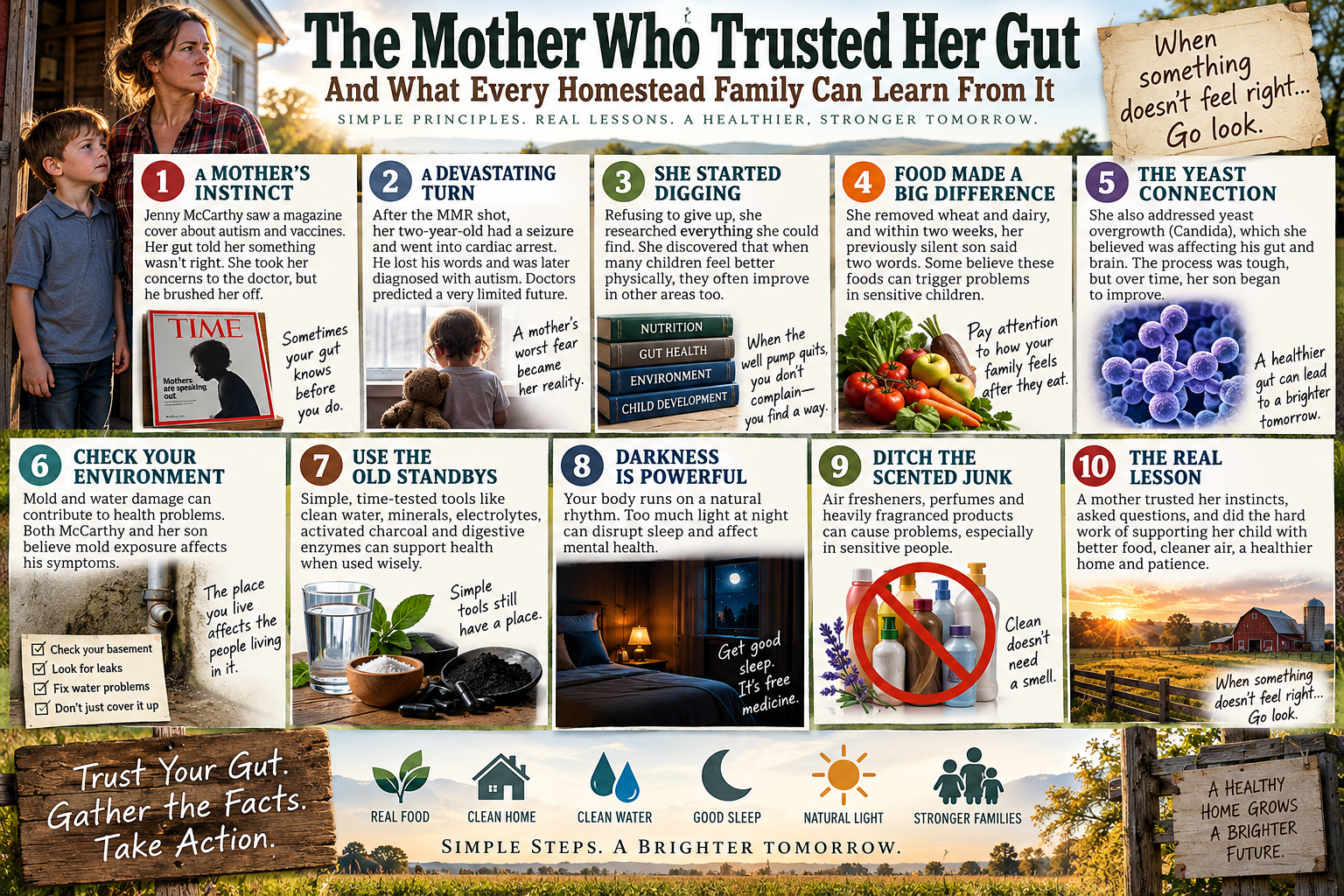
The Mother Who Trusted Her Gut… And The Lesson Every Homestead Family Should Hear
What One Mother’s Controversial Story Teaches About Intuition… Observation… And Gathering Real Facts
This story hit home because I know one of Jenny’s friends. Lots of mental pain and emotional suffering here…
She was standing in a grocery-store checkout line, holding a magazine, when her whole world seemed to tilt sideways.
Jenny McCarthy noticed a small line on the cover of Time discussing parents who believed they had seen changes in their children around the time of vaccination. Her young son was approaching another vaccination appointment, and standing there between the gum rack and the cash register, she says she felt something she couldn’t shake.
It wasn’t a carefully reasoned argument. It wasn’t something she’d researched for six months.
It was a punch in the gut.
When Your Gut Starts Talking

Don’t confuse instinct with proof. But don’t ignore it either. Notice it. Investigate it. Gather the facts.
Now, out here in the country, most of us know that feeling.
It’s the little voice that tells you to check the barn one more time before bed. It’s the hunch that makes you stop the tractor because something doesn’t sound quite right, or the feeling that says maybe today isn’t the day to try crossing that swollen creek.
Folks who live close to the land learn not to automatically dismiss those signals. Sometimes they’re wrong, of course. But sometimes your eyes, ears and experience have picked up something your conscious mind hasn’t put into words yet.
So McCarthy took her concern to her son’s doctor.
According to her account, she pleaded with him because she had a strong feeling her boy shouldn’t receive the shot. The doctor disagreed and reassured her about vaccination. McCarthy says she refused to sign the paperwork herself, her husband ultimately signed it, and she walked out of the room crying.
What happened afterward became the dividing line in her family’s life.
Her two-year-old suffered a devastating seizure and cardiac arrest.
It is important to say something clearly here: McCarthy has long connected her son’s medical crisis and later autism diagnosis with vaccination, but that does not establish that the vaccine caused his autism. Large epidemiological studies have not found that MMR vaccination causes autism.
That distinction matters.
So does what happened to her little boy.
The Longest Ride Of Her Life
Picture the scene.
A little boy turning blue. Paramedics performing CPR. A mother standing helplessly nearby while strangers fight to keep her child alive in the back of an ambulance.
McCarthy says they lost him on the way to the hospital and brought him back. Later, another medical crisis followed, and doctors placed him into a medically induced coma while they worked to control his seizures.
Then came the quiet.
And for a mother, that may have been worse.
Her son lost words he had previously used. Eventually came an autism diagnosis, followed by frightening predictions about what his future might look like. McCarthy remembers being told to prepare herself for severe lifelong limitations.
But she wasn’t built to sit beside the fence staring at a broken gate.
Homesteaders understand that stubborn streak.
When the well pump quits, you don’t spend three days admiring the hole where the water ought to be.
You start looking for a wrench.
She Started Digging Like A Farmer
So McCarthy dug into everything she could find.
She discovered Generation Rescue, an organization associated with controversial claims about autism treatment and recovery. Even McCarthy says some of what she initially encountered sounded like snake oil. Still, she kept reading, asking questions and looking for ways to improve her son’s overall health and quality of life.
That’s where this story becomes useful even if you disagree with McCarthy about vaccines, autism or almost everything else.
Because parents caring for a struggling child don’t experience that child as a diagnosis printed on a chart.
They see the stomachache.
They see the sleepless night.
They see constipation, diarrhea, allergies, anxiety, sensory problems, seizures, food problems or whatever else that particular child may be dealing with. Some autistic children do have gastrointestinal and other co-occurring medical conditions that deserve proper evaluation and treatment.
And when a child physically feels lousy, helping him feel better physically matters whether or not it changes the underlying autism.
For McCarthy, food became one of the first places she looked.
Then She Looked At The Dinner Plate
Out went wheat. Out went dairy.
McCarthy later described seeing striking improvements after dietary changes, including the return of speech. Those experiences became a major part of the story she has told publicly for years.
Biohacker Dave Asprey, during an interview with McCarthy on The Human Upgrade, discussed theories involving digestion, intestinal permeability and compounds produced during digestion of certain food proteins. Some of those ideas remain debated, and restrictive diets aren’t established cures for autism.
Still, there’s a practical lesson buried underneath the argument.
Pay attention to what happens after your family eats.
A farmer watches a field after fertilizer goes down. A cattleman watches an animal after changing feed. A gardener notices which plants thrive in one patch of soil and struggle six feet away.
We ought to be at least that observant about ourselves.
If a particular food consistently seems connected with symptoms, write it down. Talk with a qualified clinician or dietitian. Investigate instead of guessing—especially with children, where unnecessarily restrictive diets can create nutritional deficiencies.
McCarthy kept investigating.
And soon her attention turned toward the gut.
The Yeast Question
One target was Candida, a yeast that naturally lives in and on the human body but can cause genuine infections under certain circumstances.
McCarthy came to believe yeast overgrowth was contributing to her son’s problems and pursued treatments aimed at addressing it. She has described the process as difficult, followed by improvements she found remarkable.
Here again, caution matters.
Claims that vaguely defined “Candida overgrowth” causes autism, brain fog or broad collections of chronic symptoms go considerably beyond established evidence. Likewise, aggressive “detox” regimens can cause harm, particularly in children, and shouldn’t be undertaken casually.
But McCarthy’s larger point was simpler.
She stopped looking at her son as nothing more than a neurological label and started asking whether other physical problems were making his life harder.
Over the following years, she says his abilities improved dramatically. Eventually, when he was reevaluated for disability services, she says he no longer qualified for them.
Today, he’s a young adult with his own interests and online presence.
Whatever conclusions somebody draws about McCarthy’s theories, that’s a long road for a mother and son to have walked together.
Mold In The Cellar, Trouble In The House
Then the conversation with Asprey turned toward something that ought to make every old-farmhouse owner perk up.
Mold.
Asprey has spoken extensively about growing up in a home with water damage and about the chronic health problems he believes resulted from mold exposure. He recalls nosebleeds, respiratory trouble, rashes and recurring illnesses during childhood.
Some of Asprey’s broader theories about mold, bacteria, biofilms and chronic symptoms remain controversial. But the basic warning about damp buildings isn’t controversial at all.
Persistent indoor dampness and mold can contribute to respiratory symptoms and other health problems.
And that matters on a homestead.
Maybe you’ve got a 110-year-old basement with stone walls sweating every spring. Maybe the mudroom roof leaked for three years before somebody finally replaced it. Maybe the crawlspace floods every April, or the washing machine dripped behind the wall long enough to turn the studs black.
Don’t just spray something that smells like lemons over it and call the problem solved.
Find the water.
Fix the water.
Then deal with the damaged material properly.
That’s homestead medicine for the house: stop the leak before you repaint the ceiling.
Before Chasing Symptoms, Check The Environment
McCarthy and Asprey both place considerable emphasis on environmental exposures.
McCarthy has said she notices changes in her son’s symptoms when she believes mold exposure is involved. She has even described him using a phone-battery analogy for how he feels—some days, he might tell her he’s running at only five percent and needs time to recharge.
Whether mold explains any particular neurological symptom requires individual medical evaluation. But the larger habit they’re describing is useful.
Look around.
Check under the kitchen sink.
Pull the washer away from the wall.
Look behind the basement shelving. Check the sill plate, attic, crawlspace and that suspicious corner beside the sump line that hasn’t been completely dry since the Clinton administration.
Our grandparents understood something modern life sometimes encourages us to forget.
The place you live affects the person living in it.
Air matters. Water matters. Food matters. Sleep matters. Sunlight matters.
The body doesn’t live in a laboratory.
It lives in your house.
Be Careful With The “Old Standbys”
Asprey also discussed several inexpensive tools he personally uses, including activated charcoal, digestive enzymes, salt, minerals and electrolytes.
Some have legitimate uses. Activated charcoal, for example, has important medical applications in certain poisonings—but that doesn’t mean routinely taking it to “detox” is harmless. It can interfere with medications and nutrient absorption, and poison-control professionals use it selectively for good reasons.
The same common sense applies to digestive enzymes, electrolytes and salt.
More isn’t automatically better.
Someone doing hard physical work in August heat may have very different fluid and electrolyte needs than somebody sitting inside an air-conditioned house. Likewise, people with kidney disease, heart problems, high blood pressure or certain medications may need to be particularly careful about sodium and electrolyte intake.
That’s where the homesteader mentality ought to help us rather than hurt us.
We don’t pour fertilizer onto a garden because somebody on the Internet said fertilizer is good.
We test the soil first.
Treat your body with the same respect.
One Powerful Medicine Doesn’t Come In A Bottle
Then Asprey gets to something wonderfully simple.
Darkness.
Ask him which habit he’d hate to give up, and sleep-friendly darkness ranks near the top. His basic point is that the human body pays close attention to light.
Morning light says wake up.
Bright daytime light says get moving.
Darkness says the day’s work is finished.
Yet modern houses spend the evening fighting that ancient rhythm. Bright bathroom lights blaze at 10:30. Televisions flicker. Phones glow six inches from our noses. Routers, chargers, clocks and appliances turn bedrooms into little Christmas-tree displays.
Meanwhile, your brain is trying to figure out why the sun apparently refuses to go down.
Research on circadian rhythms strongly supports the importance of light and darkness in regulating sleep, and nighttime light exposure has been associated with poorer sleep and other health effects.
Country folks already have a head start.
There isn’t a streetlight every forty feet beyond the pasture.
So use the darkness you’ve got.
Hang decent curtains. Turn off unnecessary lights. Cover annoying LEDs. Put the phone down before bed and let the bedroom get so dark you can’t see your hand against the quilt.
Barn-dark.
That’s one health experiment that doesn’t require a supplement subscription.
And Maybe Your House Doesn’t Need To Smell Like “Mountain Breeze”
While you’re cleaning up the nighttime environment, take another look at what you’re breathing.
Air fresheners. Plug-ins. Scented trash bags. Dryer sheets. Perfumes. Heavily fragranced detergents and cleaning products.
Some people are particularly sensitive to fragrances and volatile compounds, and indoor air quality is worth thinking about—especially in tightly sealed modern houses.
You don’t need to panic and throw everything in the dumpster.
Just remember that “clean” doesn’t actually have a smell.
Fresh air smells like fresh air.
The Real Lesson Isn’t About Jenny McCarthy
Strip away the celebrity name, the vaccine controversy, the biohacking language and twenty years of Internet warfare, and there’s a more useful story underneath.
A mother thought something was wrong.
Professionals didn’t always agree with her interpretation. Some of her conclusions remain sharply disputed today, and several treatments promoted in the autism world have little evidence behind them or carry genuine risks.
But she kept watching her child.
She kept asking questions.
She paid attention to food, sleep, environment and physical symptoms. She refused to accept that a diagnosis meant every other health complaint should simply be folded underneath that diagnosis and forgotten.
That’s a lesson worth carrying back to the homestead.
Because self-reliance doesn’t mean distrusting every doctor.
And it doesn’t mean swallowing every alternative-health claim that wanders across your Facebook feed, either.
It means paying attention.
It means asking questions when something doesn’t add up. It means getting another medical opinion when necessary, checking the evidence, watching patterns and remembering that nobody knows the day-to-day details of your family quite like the people living under your roof.
McCarthy became controversial enough that Time famously asked whether she was dangerous, criticism she embraced rather than ran from.
But celebrity battles aren’t the part of her story I find most interesting.
It’s that moment in the checkout line.
Most people who’ve spent enough years on a piece of ground know the feeling.
Something isn’t right.
Maybe you can’t explain it yet. Maybe the cattle are acting strange. Maybe the pump sounds different. Maybe there’s a faint smell of hot wiring in the shop, or the dog keeps staring toward a barn that should be empty.
You don’t have to panic.
You don’t have to invent an explanation.
And you certainly don’t have to assume your first theory is right.
But you do go look.
That’s the difference.
So when that little alarm starts ringing somewhere down in your gut, don’t blindly obey it—and don’t automatically silence it, either.
Go gather facts.
Ask questions.
Check the house. Check the food. Check the water. Call somebody who knows more than you do.
And if necessary, get a second opinion.
Because sometimes wisdom doesn’t arrive carrying a clipboard.
Sometimes it whispers while you’re standing beside the fence:
Go check the barn.