 Print
Print

How A Dutch Debate 54 Years After Calvin’s Death… And A TULIP Invented Centuries Later… Came To Unfairly Define The Man
A 17th-Century Dutch Debate And A 20th-Century Acronym Somehow Became “Calvinism.” But When You Go Back To Calvin Himself, The Story Gets A Lot More Interesting.
Any orchardist knows you don’t judge a tree by one branch. You don’t cut off one limb, carry it into the house, lay it on the kitchen table and announce, “Well, now I understand the whole tree.” You’d miss the roots, the trunk, the other branches, the soil it grew in and most of the fruit hanging out there in the sunshine.
Yet that’s exactly how we often handle theology. The fancy word for it is reductionism: taking a handful of a man’s ideas out of a lifetime of work and presenting those ideas as though they were the whole operation. It’s how a 700-page thinker gets boiled down into something that’ll fit on a bumper sticker.
And there may be no cleaner example in church history than what we’ve done to John Calvin.
Say “Calvinism” in most American churches today and somebody can probably give you five points before the coffee finishes brewing: Total Depravity. Unconditional Election. Limited Atonement. Irresistible Grace. Perseverance of the Saints. TULIP.
Entire denominational fights, seminary debates, dinner-table arguments and social-media cage matches have been built around those five letters. There’s just one rather awkward problem.
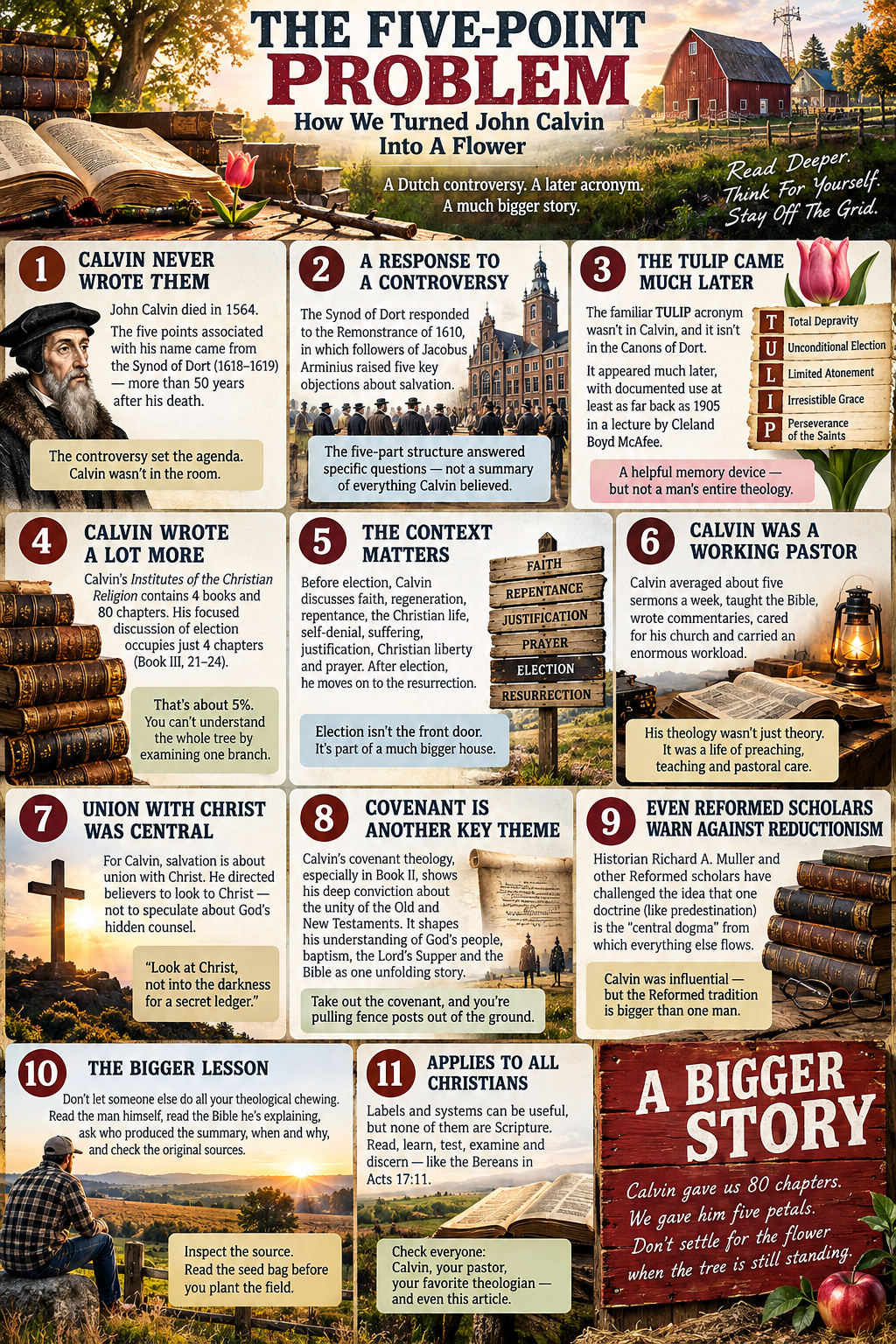
John Calvin never wrote them.
First, The Timeline Doesn’t Work
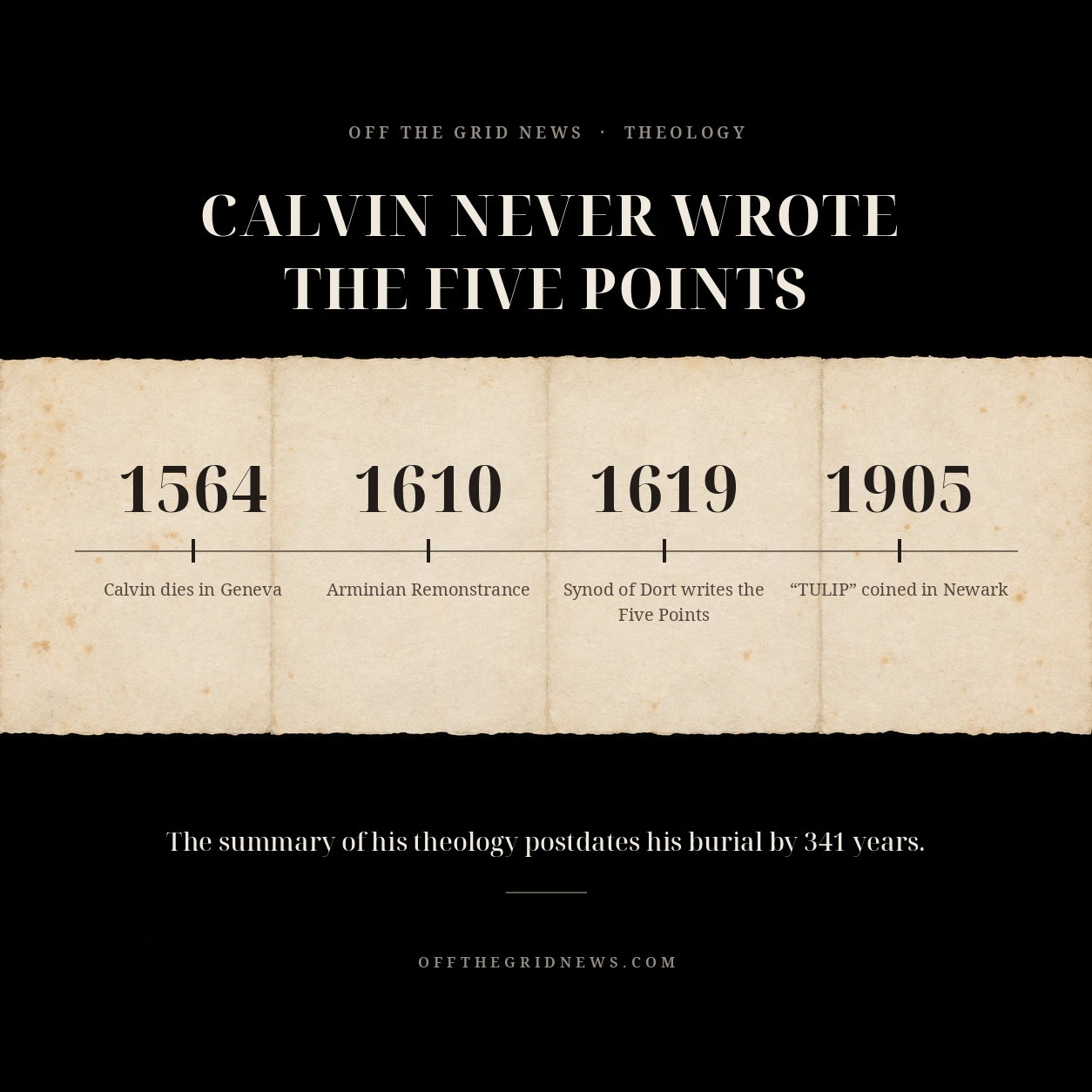
Listen, Calvin died in Geneva in 1564. The five points now so closely associated with his name emerged from a controversy answered at the Synod of Dort, which met in Dordrecht, Holland, from November 1618 until May 1619… more than half a century after Calvin’s death. You can read the resulting Canons of Dort here.
In other words, Calvin wasn’t sitting in the room, and the men at Dort weren’t gathering around a big oak table asking, “How can we boil John Calvin’s entire theology down to five handy points?” That’s not what happened.
Instead, the Synod was called to answer a specific theological challenge. Followers of Jacobus Arminius had produced the Remonstrance of 1610, laying out five articles disputing particular elements of Reformed teaching concerning salvation, and Dort responded to those disputed questions.
So the five-part structure was shaped in large part by the controversy being answered. The resulting Canons addressed those particular issues because those were the issues sitting on the table, not because somebody had discovered Calvin’s secret five-point table of contents.
That distinction matters because the five points weren’t written as a summary of everything Calvin believed. They were much closer to a theological legal brief: somebody presented objections, and the other side responded to them.
The controversy helped set the agenda. Calvin didn’t.
Then Somebody Planted The TULIP
Here’s where the story gets even more interesting. The familiar TULIP acronym isn’t in Calvin, and it isn’t in the Canons of Dort either. You won’t find that tidy little flower blooming in either source.
The acronym appears much later. The PCA Historical Center’s examination of TULIP’s origins traces its documented use as a teaching device at least as far back as a lecture by Presbyterian minister Cleland Boyd McAfee before the Presbyterian Union in Newark, New Jersey, around 1905.
From there, TULIP became an extremely useful memory device in English-speaking Protestant circles. And that’s fine… memory devices are supposed to make complicated ideas easier to remember.
But a memory device isn’t the same thing as a man’s theology.
So think about the distance we’ve traveled. A sixteenth-century Reformer died in 1564; a Dutch controversy produced a five-part response more than half a century later; then centuries after that, those doctrines were packaged into a memorable English flower.
Eventually, the flower became the man.
That’s a pretty long theological game of telephone.
Walk Out To The Field And Count The Rows
If we want to know what Calvin himself considered important, there’s a wonderfully old-fashioned way to find out: read Calvin. His great theological work was the Institutes of the Christian Religion, which he repeatedly revised and expanded over the course of his career.
The final 1559 edition contains four books and 80 chapters, and you can browse the entire table of contents and text of Calvin’s Institutes at Christian Classics Ethereal Library.
Now look at where Calvin’s concentrated treatment of predestination and election appears. The discussion occupies Book III, chapters 21 through 24: four chapters out of eighty.
That’s about five percent of the chapters in the finished work. Chapter counts aren’t an inspired measure of theological importance, of course, but they do tell us something about proportion.
If a farmer plants 80 rows and four of them contain sweet corn, you probably shouldn’t describe the entire operation as a sweet-corn farm. Yet that’s awfully close to what we’ve done with Calvin.
And Where Calvin Put It Matters
Even more interesting is where those chapters occur. Calvin doesn’t open Book III with predestination and then build the entire Christian life outward from some mysterious hidden decree.
Instead, before reaching election, he works through faith, regeneration, repentance, the Christian life, self-denial, suffering, justification, Christian liberty and prayer. You can see the sequence yourself in the primary-source table of contents for Book III.
Only after all of that does Calvin arrive at chapters 21–24 and his sustained treatment of election. Then chapter 25 immediately moves to the resurrection.
That’s important because theological architecture tells you something. Where’s the front door? What’s in the kitchen? What’s stored in the barn? What did the builder make you walk past before reaching the back room?
Calvin’s doorway wasn’t, “Before anything else, let us speculate about who was secretly predestined.” His Institutes famously begins with the relationship between the knowledge of God and knowledge of ourselves, and Book I concerns the knowledge of God the Creator.
That’s the front gate into Calvin’s theological farm.
Meanwhile, Book IV is devoted to the church, its ministers, authority, discipline, baptism and the Lord’s Supper. Already, the landscape looks considerably bigger than five petals.
Look At What The Man Actually Did All Day
Books tell us something about a man, but his calendar tells us something too. Calvin wasn’t sitting in an ivory tower spending every waking hour diagramming predestination; he was a working pastor, preacher, Bible lecturer and commentator carrying an enormous workload.
Historical accounts of Calvin’s Geneva ministry describe a relentless preaching schedule. One overview notes that Calvin commonly averaged about five new sermons a week, in addition to biblical lectures, commentary writing, theological writing, correspondence and pastoral responsibilities.
In other words, the fellow spent an enormous portion of his life simply opening the Bible and explaining it.
Meanwhile, Calvin produced commentaries across a huge portion of Scripture. And when you actually wander through those sermons and commentaries, you encounter a much broader Calvin than the fellow who shows up in internet arguments.
There is sin and grace, certainly, but there’s also worship, prayer, honest work, suffering, government, poverty, family life, patience, Christian duty and how ordinary believers ought to live when life gets hard. It’s an entire theological homestead.
We keep arguing over one corner of the pasture.
The Theme Hiding In Plain Sight: Union With Christ
Here’s another piece that gets lost when Calvin gets reduced to TULIP. One of the great organizing themes in his understanding of salvation is unio cum Christo — union with Christ.
Book III itself is about how believers receive the grace of Christ and the benefits flowing from it. Calvin’s own introductory argument explains that the Holy Spirit brings believers into the enjoyment of Christ and His benefits, making this communion with Christ foundational to what follows.
That matters a lot when we get to election because Calvin didn’t want frightened Christians endlessly rummaging around in God’s secret counsel, trying to peek behind heaven’s curtain and discover whether their names were written on some invisible list.
Instead, he pointed them toward Christ.
In Institutes 3.24, Calvin argues that God’s hidden election becomes known through calling and directs believers away from reckless speculation about God’s secret counsel.
Elsewhere in that discussion, he famously describes Christ as the “mirror” in whom believers contemplate their election. Whatever disagreements we may have with Calvin’s doctrine, that’s a very different pastoral picture from the one painted by a thousand internet debates.
For Calvin, election wasn’t supposed to become ammunition for theological trench warfare. It was supposed to drive the Christian’s eyes toward Christ rather than leave him digging around in God’s hidden counsel.
Don’t stare into the darkness looking for a secret ledger. Look at Christ.
Then There’s The Covenant… Another Huge Piece We Forget
Another major theme running through Calvin’s theology is covenant. His treatment of the relationship between the Old and New Testaments appears prominently in Book II, especially chapters 10 and 11, where he argues for their fundamental unity rather than treating them as two unrelated divine programs.
That covenant thinking doesn’t stay fenced into one theological pasture, either. It shapes Calvin’s understanding of God’s people, biblical history, baptism and the Lord’s Supper, and it helps explain how he reads the Bible as one unfolding story rather than a pile of disconnected religious documents.
Pull covenant thinking out of Calvin and you’re not trimming a little twig off the theological tree. You’re yanking fence posts out of the ground.
Even Reformed Scholars Warn Against The Caricature
This isn’t some clever anti-Calvinist trick. Major scholars working within the Reformed tradition have themselves warned against treating predestination as the single master doctrine from which every other part of Calvin’s theology supposedly flows.
Historian Richard A. Muller, one of the foremost modern scholars of Reformed orthodoxy, became especially associated with challenging what historians call the “central dogma” thesis … the attempt to explain an entire theological system by locating one doctrine at its center and making everything else radiate outward from it.
Muller’s broader work also reminds us of something easy to forget: the Reformed tradition was bigger than one man. Calvin was enormously influential, but he wasn’t the lone blacksmith standing at the forge hammering an entire theological tradition into existence.
That’s another fence worth checking before we lean too hard against it.
Off-The-Grid Theology Means Reading The Label Yourself
Now we get to the part that matters beyond Calvin. You can agree with Calvin on election, disagree with him, or land somewhere in the middle and manage to irritate everybody.
That’s not really the point.
The deeper issue is method, and method is where Off-The-Grid Theology comes in. If there’s one lesson homesteading teaches quickly, it’s that you better learn to inspect things yourself.
You don’t buy a used tractor just because the salesman slaps the hood and says, “Trust me, she runs great.” You pop the hood, check the oil, listen to the engine, look at the tires and crawl underneath to see whether there’s a puddle somebody conveniently wiped away ten minutes before you arrived.
Theology deserves at least that much care.
Because reductionism is one of the easiest ways to get sold a bill of goods. Somebody gives you the pre-chewed version, you repeat it, your pastor heard it from his professor, his professor got it from a textbook, and the textbook summarized another textbook.
Pretty soon everybody “knows” what somebody believed while hardly anybody has bothered walking out to the barn and opening the original crate.
That’s theological dependence.
Read The Seed Bag Before You Plant The Field
The correction isn’t glamorous: read the man himself, and then — far more importantly — read the Bible he’s claiming to explain. Notice what a theologian actually spends his time discussing instead of looking only at the doctrines his opponents found controversial.
Then ask some basic questions. Who produced the summary you’re being handed? When did they produce it? What controversy were they answering, and what argument were they trying to win?
In Calvin’s case, those questions produce fascinating answers. The five-part controversy we now associate with his name was formalized at Dort decades after he died, while the familiar TULIP teaching device appears centuries later.
Meanwhile, Calvin left behind four books and eighty chapters of the Institutes, a mountain of sermons and an enormous body of biblical commentary. Yet somewhere along the way, we took all that lumber, stacked it behind the barn and remembered the flower sitting on the kitchen table.
Five petals.
Never Let Somebody Else Do All Your Theological Chewing
There’s a broader warning here for every Christian, whether Calvinist, Arminian, Lutheran, Baptist, Catholic, Orthodox or the fellow sitting in the back pew who hasn’t figured out what label fits him yet. Labels can be useful, and theological systems can be useful too, but neither one is Scripture.
Theological heroes aren’t Scripture either. Augustine, Aquinas, Luther, Calvin, Wesley, Edwards, Spurgeon… every one of them was a man who could teach us something, and every one of them still had to be tested against the Word of God.
So read them. Learn from them. Argue with them when necessary, and appreciate them where they’re right.
But don’t confuse their maps with the territory.
That’s what Off-The-Grid Theology ought to mean. It doesn’t mean theological isolation, pretending 2,000 years of church history never happened, or assuming we’re automatically smarter than everybody who came before us.
Instead, it means refusing to outsource the responsibility God gave ordinary believers to read, test, examine and discern. The Bereans were praised because they received Paul’s message eagerly and then “examined the Scriptures daily to see if these things were so” (Acts 17:11).
If they checked Paul, we can probably check Calvin.
And me.
And your pastor.
And your favorite YouTube theologian.
Calvin gave the church eighty chapters of the Institutes, a mountain of sermons and biblical commentary spanning most of Scripture. We handed him a five-petal flower and called it even.
That’s not an assessment. It’s an abbreviation.. and no theologian should be read by his abbreviation.