 Print
Print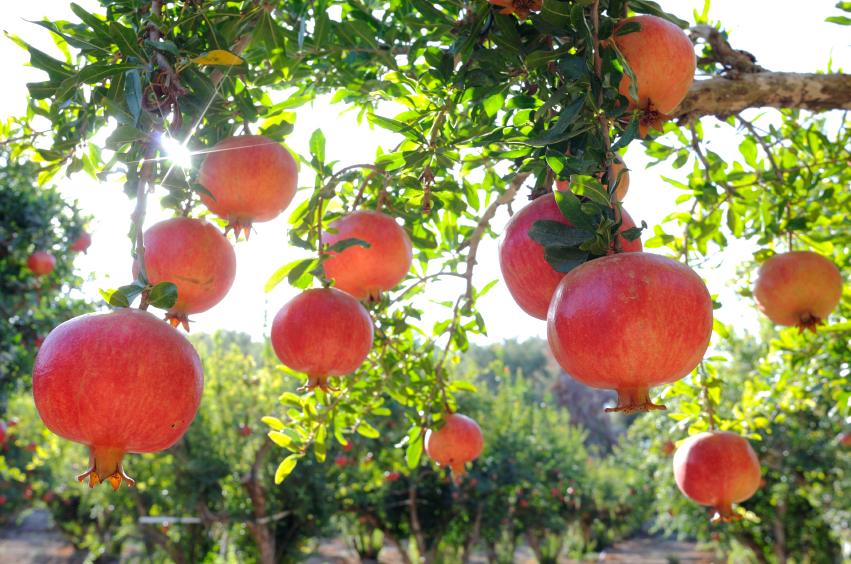
Many orchard and berry fruits, including apples, pears, currants and raspberries, don’t really grow well in hot climates. Fortunately,
there’s an alternative for almost every gardening situation. Citrus fruits, nuts and blackberries thrive in warm climates, and let’s not forget pomegranates.
Pomegranates (Punica granatum L.) have an ancient history and were repeatedly mentioned in the Bible. Native to Iran and the Himalayan Mountains, pomegranates spread throughout the Mediterranean region and northern Africa. They were introduced to North America by Spanish Explorers in 1769.
Pomegranates grow best in hot, semi-arid climates, making them somewhat problematic for the Deep South, where humidity is a constant. In the US, they grow best in southern California and Arizona. Although they’ll survive as far north as southern Utah, they probably won’t bear fruit.
Planting Pomegranate Trees
Pomegranates grow best in a warm, sunny location, such as an area next to a cement wall or a place that gets southern exposure. They tolerate the poor, gravely, alkaline soils found in many parts of Arizona, but they do best in average, well-drained soil.
Pomegranates are somewhat drought tolerant, but they produce better fruit if they’re watered occasionally. Water young pomegranates every week during the first growing season. Water established plants every two to four weeks.
Pomegranates have a tendency to sucker and they’re often grown as a shrub, rather than a tree. Prune young plants when they stand 2 feet tall to leave four or five strong branches. If you want a tree, remove suckers as they appear every spring. Dwarf varieties are available, but most plants reach 12 to 15 feet tall. The branches may have spines.
Caring For Pomegranate Trees
Pomegranate trees are long-lived. Some plantings in Europe are more than 200 years old. However, they perform best for only 15 to 20 years. Fertilize pomegranate trees in the spring with 2 ounces of aluminum sulfate. If you have moderately rich soil, you might not need to fertilize at all. Plantings near a fertilized lawn also probably don’t need additional fertilizer.
New Natural Fertilizer Doubles Garden Production!
The trees may bear fruit as early as one year after planting them, but two to three years is more common. The trees produce large scarlet or white flowers in the spring. The flowers have a fleshy calyx in the center. The flowers are self-pollinated and pollinated by bees. Planting more than one tree isn’t necessary, but it will increase fruit production and improve quality.
The fruit matures slowly over 5 to 7 months, ripening in late fall. Pomegranate fruits need hot, dry weather to mature properly. Cool or rainy weather might cause them to crack. Harvest pomegranates when they’re almost mature. When ready, they’ll have a metallic sound when tapped. The leathery skin will be firm and the fruit will be of mature size.
Pests And Diseases
Because pomegranates grow mostly in dry areas with poor soils, they rarely suffer disease or pest problems. When grown in humid conditions, of course, the incidence of disease increases. The most common disease problems are leaf spots, but they’re rarely serious. In most cases, they can be ignored. Rake up and remove leaf litter so diseases don’t overwinter.
Aphids, whiteflies and scale insects sometimes infest pomegranates. Thwart aphids and whiteflies with a steady stream of water or spray the trees with horticultural oil. Make applications on overcast cool days. Horticultural oil can burn the leaves if applied during hot, sunny weather.
Storing Pomegranates
The season for pomegranates in the store is all too brief, typically lasting from late October to January to coincide with the holiday season. Home-grown pomegranates, though, can be stored for up to seven months. Store pomegranates in perforated plastic bags in the produce bins of your refrigerator. The temperature should be set between 32 and 40 degrees. When stored this way, the fruit’s quality improves during storage.
Using Pomegranates
Pomegranates are a rather unique fruit. They have a thick, leathery shell which covers hundreds of tiny seeds. The seeds are surrounded by a juicy, gelatinous substance and the seeds are held in packets contained by bitter, inedible membranes.
To open a pomegranate, run your knife vertically along the fruit to score it deeply. Then press on the markings to break open the fruit. Carefully remove the seed packets and separate the seeds.
The process is rather messy and the juice can cause stains. Wear an apron and break open a pomegranate in a deep bowl or in a bowl set in the sink. Pomegranate seeds can be eaten out of hand as a snack or tossed in salads.
To juice a pomegranate, you can press the seeds over a citrus reamer or extract it with a juicer. Another option is to warm the fruit in hot water. Then cut one end off the pomegranate and set it over a glass. Squeeze on the upper portion of the fruit to slowly allow the juice to run into the glass. This method takes the longest, but it also creates the least mess.
Pomegranate Nutrition
Pomegranate juice has become a hot commodity recently. Lauded for its high levels of antioxidants, pomegranate seeds and juice have been shown to potentially reduce the risk of cancer or heart disease.
One pomegranate contains about 50 percent the daily recommended allowance of calcium and pantothenic acid. One pomegranate has only 140 calories and 399 mg. of potassium.