 Print
Print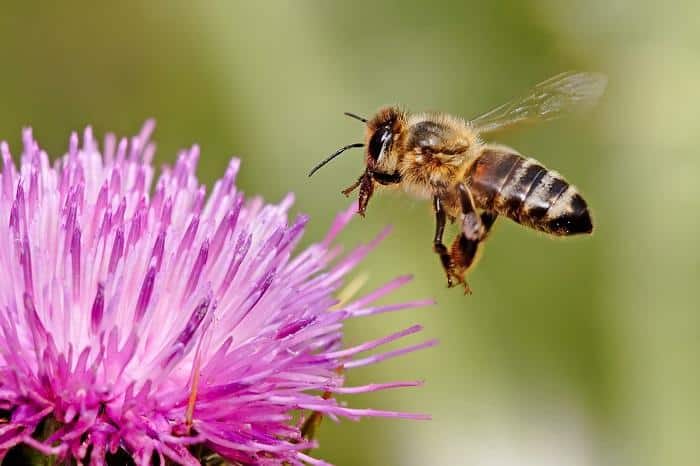
Honeybees don’t just pollinate our orchards (apples, pears, peaches, plums, almonds, grapefruits, oranges, cherries), but they also pollinate berries (blueberries, blackberries, and raspberries) as well as onions, pumpkins, cucumbers, cantaloupe, watermelons and a host of other food plants.
Falling bee populations doesn’t negate the absolute necessity of these little winged insects. So, how can we make the best use of the populations out there or ones we maintain ourselves? Actually, it appears that honeybee populations are helped by wild bee populations. Better pollination and better fruit production result from a synergistic combination of multiple bee species.
Two studies, conducted by the University of California, Berkeley, the University of California, Davis, and Germany’s Leuphana University of Luneberg, were recently published showing that bee diversity plays a large role in more thorough pollination of produce and orchards.
The first study (results published in Global Change Biology, November 2012) found that different types of bees visited different portions of trees. Honeybees seemed to prefer the higher flowers while wild bees visited the lower branches, resulting in a more thoroughly pollinated tree and better fruit appearance. The second study (results published in January 2013 in Proceedings of the Royal Society B: Biological Sciences), showed that honeybees tended to forage along one side of rows of trees.
The Ultimate Guide to Keeping Stronger Colonies and Healthier, More Productive Bees
For trees like almonds that require cross-species pollination, positive results were seen in orchards that had a variety of bee species. Honeybees changed their foraging patterns in the presence of other species, leading to them visiting multiple rows (different almond species) more frequently.
So, in short, even if you have your own honeybee hives, it’s most likely beneficial for you not only to care for your own bees but lure in wild bees as well. And certainly if you don’t have your own hives, then attracting wild bees will be a definite priority for you. But how do you draw them in? There are a number of things we can do to bring these little creatures buzzing into our orchards and gardens.
POLLINATOR FOOD
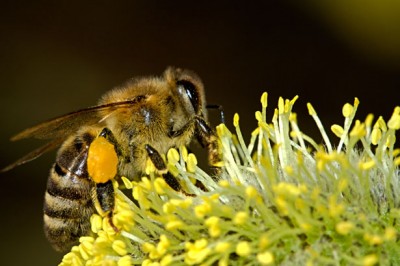 Choose plants that attract bees. The North American Pollinator Protecting Campaign (NAPPC) provides a list of generic plants (including lavender, rosemary, sage, coneflower, sunflower, redbud, catnip, penstemon, lamb’s ears, verbena, bells and phacelia, aster, black-eyed Susan, oregano, and yarrow) that can be grown in the lower 48 states to attract pollinators. Chances are you already have some of these in your garden and orchard, but determine if you have full season coverage. Bees need food sources throughout the growing season. The NAPPC has also written handy guides specific to various North American regions to help people determine the best plants for their area.
POLLINATOR HOMES
To encourage wild bee species to stick around your orchard and garden, you’ll need to make sure suitable nesting options are available. Most wild bees are solitary nesters, and depending on variety, may burrow into the ground (miners), nest in holes they find (masons, leafcutters, and bumblebees) or bore into wood (carpenters). Depending on the bee species in your area, you may want to leave portions of the ground bare and open so that miners can nest. You can also purchase or make your own solitary bee nests. This can be a board or log with some holes drilled into it, or something more elaborate resembling a birdhouse with a little roof and with multiple holes throughout.
POLLINATOR HEALTH
Maintaining the health of your own honeybees as well as wild bees is of the utmost importance. While ensuring diverse food availability and providing suitable nesting habitats for bees is an excellent place to start, you need to curtail chemical use as much as possible as well. Native Bee Conservancy, an organization dedicated to ensuring the survival of wild bees, writes, “All types of pesticides have been found to harm bees, including fungicides, herbicides, acaricides, rodenticides, and of course the ubiquitous insecticides.” So, before you bring any chemicals into your yard, orchard, or garden, seek other alternatives.
If you must use a chemical product, try to stay away from broad-spectrum ones especially. Try to apply the product when there is no wind to curtail drift and use it only when it’s warm out so that the toxicity of the product will dissipate sooner. The National Agroforestry Center states that granular and solution formulations are generally less hazardous than dust or wettable powder formulations. Choose other alternatives to pesticides whenever possible.
This year, keep in mind how crucial bee pollination is of your produce and fruit. Focus on ways to encourage both wild and honeybee populations to thrive. As the trees wake up and start to blossom and your garden begins to flourish, you’ll be able to see the bees in action and by fall (if not before), you’ll be experiencing the immense benefits of synergy between wild bees and honeybees!
Sign up for Off The Grid News’ weekly email and stay informed about the issues important to you