 Print
Print
Radishes are highly underrated vegetables. Occasionally, they might make an appearance on someone’s veggie platter, or be sliced into a salad, but they don’t seem to get the kind of heavy rotation in kitchens as carrots and broccoli do. That’s too bad, because those peppery and crunchy globes are packed with healthy benefits. Radishes are an excellent source of vitamin C, and are also a source of folate, fiber, riboflavin, potassium, copper, vitamin B6, magnesium, manganese and calcium. They are a natural diuretic, as well.
But wait! There’s more! Radish sprouts and greens have the same peppery flavor as the bulbs, and they’re good for you, too. The greens are packed with potassium, iron, vitamin A, vitamin C, phosphorus and thiamine. Like the bulbs and the greens, radish sprouts are also an excellent source of vitamin C, as well as a good source of folate, niacin, vitamin B6, and manganese.
On top of the health benefits, radishes are super easy to grow. As a cool-weather crop, they can do well in the cooler areas of your home during the winter. And within about 1-2 weeks of seeding, you can harvest radish sprouts and microgreens. Depending on the variety, the bulbs will be ready for harvest in as little as one month after seeding.
Radish Sprouts
If you’re aiming for radish sprouts, it’s best to buy seeds that are specifically sold for sprouting. They are more expensive than regular vegetable seeds, but they are cleaned better by the producer; they should be certified to be free of pathogens; and they have a high germination rate.
Angela Counter has an excellent tutorial here on Off The Grid News on how to grow sprouts . But, a note specific to radish seeds: They’re floaters by nature. If necessary, during the first step of soaking the seeds for 8-12 hours, push them underwater until they become waterlogged and sink. Once that first soak is done, it’s just a matter of rinsing and draining the seeds a few times a day until they have sprouted and are ready to harvest.
Need Non-GMO Vegetable Seeds? Get Them From A Company You Can Trust!
You should have edible sprouts within five to six days. Before eating, it’s best to dehull them just in case all the seed shells have not already fallen off. Dehulling is easily done by submerging the sprouts in water and swishing them around with your hand. Any remaining shells will pop off and float on the water, making them easy to remove.
Radish Microgreens, Greens And Bulbs
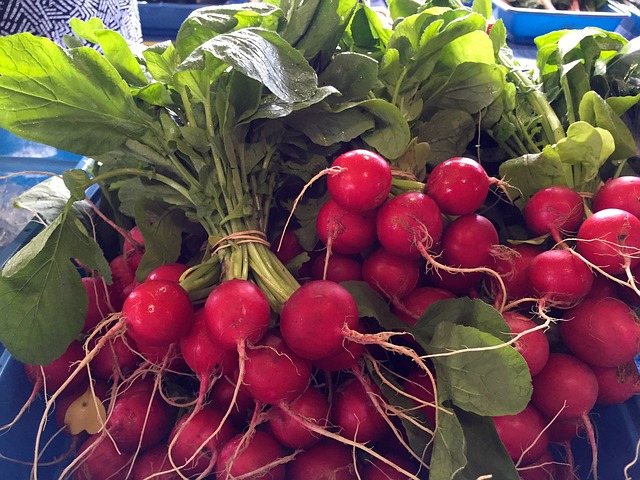
Even though radishes are a root vegetable, they can be grown in fairly shallow containers, like plastic seedling trays. The trays work great because they are large enough to provide a decent harvest of microgreens and greens while you wait for your bulbs to mature. Keep in mind, though, that if you use shallow containers, you will need to fertilize about once a week, since the small amount of soil will be quickly depleted of nutrients.
Choose radish seeds that will produce compact round bulbs, rather than cylindrical tubers. Some varieties to consider are Perfecto, Sparkler, Ping Pong and Cherry Belle.
Start by filling the trays with purchased soil and mix in some compost. The soil should be loose to encourage root development. Because you’re aiming to harvest microgreens, the seeds can be densely planted in rows that are spaced 3-4 inches apart. Once planted, the trays require at least six hours of direct light a day, which can be supplemented by a grow light if necessary. Keep the soil moist but not wet.
You should be able to start harvesting microgreens within 1-2 weeks of planting. It’s best to use scissors to snip the microgreens out. Because the seeds are densely planted, yanking the greens out will likely disturb — or even dislodge — nearby greens. If you intend to let some of the plants mature enough to produce edible bulbs, keep in mind that the ideal spacing for radish plants is about 1.5-2 inches.
If you’re aiming for radish greens, they are best when young and tender — when the root of the radish is still slim. Some radish varieties are a better choice for salad greens. If you’re hoping to toss raw radish greens into your salads or sandwiches, choose “hairless” varieties, like Perfecto. Otherwise, it can take some adjusting to get used to the slight fuzziness or roughness of radish leaves, especially the more mature ones. But, radish greens also can be added to soups, stir-fries, or casseroles, or even made into pesto, which negates any concern for their texture.
The radishes themselves may take a little longer to mature indoors than if grown outdoors. Don’t be surprised if they take a week or two longer than indicated on the package. Just be patient. It’ll be worth it.
Every Year, Gardeners Make This Stupid Mistake — But You Don’t Have To. Read More Here.