 Print
Print
Inside The World Economic Forum’s New “Purpose-Driven” Economic Network
They Don’t Have To Outlaw Your Farm… Just Follow The Money… The Metrics And The Entrepreneurs… And Something Much Darker Starts To Come Into View
There are certain words that ought to make an old farmer reach for his reading glasses. They sound harmless enough when you first hear them, almost like something dreamed up by a marketing department over coffee and doughnuts.
“Purpose-driven” is one of them. Remember Rick Warren, right?
Well, on the surface, it sounds nice. Who doesn’t want a business with a purpose? The family farm has a purpose. The hardware store in town has a purpose. The fellow repairing diesel tractors in the pole barn down the road certainly has a purpose.
But when the World Economic Forum starts talking about building “purpose-driven” corporations and entrepreneurs, it might be worth setting down the coffee cup and asking one very old-fashioned question:
Whose purpose?
Because once you start digging through the World Economic Forum’s own documents, reports and initiatives, something interesting appears. This isn’t merely about encouraging businessmen to become better neighbors or corporations to donate a little more money to the local food pantry.
There is an entire framework taking shape around the idea.
First, They Wanted To Change The Corporation

You have to go back more than a decade to see where this trail starts.
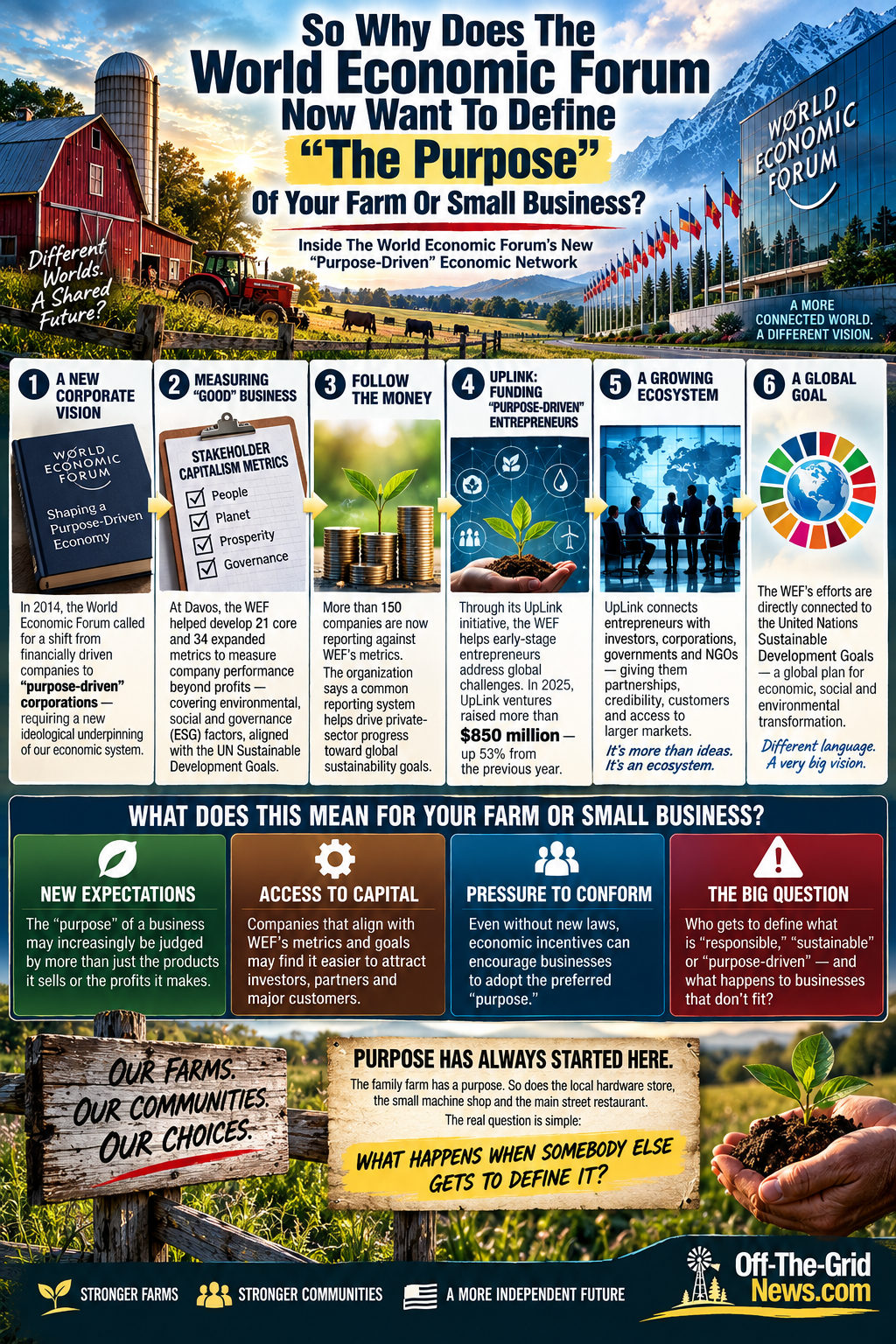
In 2014, the World Economic Forum published an article discussing the transformation of financially driven companies into “purpose-driven” corporations. The article argued that accomplishing that transformation would require a “shift in the ideological underpinning of our economic system.”
Read the 2014 World Economic Forum article
Think about those words for a minute. We’re not talking about improving customer service, making corporations more charitable or encouraging companies to treat their workers fairly.
We’re talking about changing the ideological underpinning of the economic system.
Suddenly, “purpose-driven” starts sounding considerably bigger than the motivational poster hanging in Human Resources.
Then Came “Stakeholder Capitalism”
The basic argument behind stakeholder capitalism is fairly simple. A corporation shouldn’t concern itself only with owners and shareholders; it should consider employees, communities, environmental concerns and other so-called stakeholders when determining how the business operates.
There are perfectly reasonable arguments for businesses behaving responsibly. Nobody wants a factory dumping poison into the creek behind the elementary school.
But the important question isn’t whether companies should behave responsibly.
It’s who gets to define “responsible.”
And that is where this story gets interesting.
At the World Economic Forum’s 2020 Davos meeting, 120 of the world’s largest companies supported efforts to develop common measurements for corporate performance beyond traditional financial results. Following consultation involving more than 200 companies, investors and interested parties, the Forum ultimately published 21 core and 34 expanded Stakeholder Capitalism Metrics and disclosures.
These weren’t measurements of how many tractors rolled off the assembly line or how many refrigerators a company sold. They covered environmental, social and governance performance under four broad pillars: People, Planet, Prosperity and Principles of Governance.
And the World Economic Forum explicitly connected the broader measurement effort with progress toward the United Nations Sustainable Development Goals.
Now the fence posts start lining up.
What Gets Measured Eventually Gets Managed
Spend a little time actually reading through the World Economic Forum’s Stakeholder Capitalism Metrics, and you’ll discover something important.
Some measurements concern things most ordinary Americans would consider perfectly reasonable corporate responsibility. Workplace safety and corruption are hardly radical concepts.
But the measuring stick extends considerably farther.
The framework includes greenhouse-gas targets, diversity measurements, social investment and something called “governing purpose.” It asks companies to explain how their stated purpose addresses economic, environmental and social issues—and how that purpose is embedded into company strategies, policies and goals.
That’s worth remembering.
Because once somebody starts measuring whether your “purpose” has been properly embedded into your strategy, we’re no longer talking about a slogan painted above the receptionist’s desk.
We’re talking about management.
Follow The Money
Imagine two companies sitting across the kitchen table.
One fits the preferred measurements beautifully. Its environmental targets align. Its corporate reporting aligns. Its social objectives align. Its stated purpose aligns.
The other fellow scratches his beard and says:
“I make hydraulic pumps. I make good ones. I pay my workers well, obey the law, take care of my customers and make a profit.”
Which company eventually looks better inside a financial and corporate ecosystem increasingly interested in measuring non-financial performance?
That doesn’t prove anybody is going to shut Hydraulic Pump Bob out of the economy. But it does explain why Americans ought to pay attention to the measuring stick being built.
By 2024, the World Economic Forum reported that more than 150 companies were reporting against its Stakeholder Metrics, with many having done so for multiple years. The Forum itself said that a common reporting system is important for private-sector progress toward the UN Sustainable Development Goals.
See WEF’s report on companies adopting the metrics
Once everybody starts using the same ruler, whoever helped mark the inches has considerable influence over what “good” looks like.
Now Meet UpLink
Here’s where the story gets even more interesting.
The World Economic Forum operates an initiative called UpLink, designed to identify and help scale entrepreneurs addressing major global challenges. WEF openly describes the ecosystem as helping “purpose-driven entrepreneurs” grow early-stage ventures.
And this isn’t some little Davos discussion group.
According to the Forum’s 2025 UpLink Impact Report, the initiative had a community of more than 500 Top Innovators supported by more than 300 ecosystem partners. In 2024 alone, those innovators collectively raised $633 million in investment capital.
Read WEF’s 2025 UpLink Impact Report
The Forum says these ventures are working on climate change, biodiversity, water security, ocean degradation and sustainable industry. It also describes the ecosystem as bringing together entrepreneurs, investors and industry leaders while helping entrepreneurs secure funding, increase customers and scale their businesses toward the Sustainable Development Goals.
That’s real money moving into real businesses.
And the machine is getting bigger.
$633 Million Became More Than $850 Million
The newest numbers make the trend even harder to ignore.
In its 2026 UpLink Annual Impact Report, the World Economic Forum says UpLink ventures raised more than $850 million during 2025, representing a 53% increase in capital from the previous year. The Forum says UpLink exists to help ventures obtain the partnerships, credibility and market access necessary to scale into critical systems including water, climate, nature, cities, health and emerging technologies.
Read WEF’s 2026 UpLink Annual Impact Report
That matters because we’re no longer merely discussing an ideology.
We’re discussing an ecosystem capable of connecting selected entrepreneurs with capital, credibility, partnerships and markets.
Those are the things that turn ideas into economic power.
That’s Why I Keep Thinking About A Franchise
Now, let’s be precise.
I have found no evidence that the World Economic Forum literally calls this a “Purpose Driven franchise.” There isn’t some Davos McDonald’s where somebody hands you a corporate playbook, a paper hat and a set of golden arches.
But stand back from the individual pieces and look at the machinery.
First comes the purpose, followed by internationally recognized social and environmental goals. Then come standardized measurements, corporate reporting, participating companies, investors and “purpose-driven entrepreneurs.”
After that come networks designed to help those entrepreneurs scale. Then come funding, partnerships, credibility, customers and access to larger markets.
Maybe “franchise” isn’t the technically correct word.
But you can certainly understand why somebody standing outside the machine might use it.
The Most Important Question: Who Writes The Purpose?
This is where an old homesteader’s instincts come in handy.
Out here, purpose grows from the ground up. A farmer decides what he’s going to plant. A family decides what kind of life it wants. A carpenter decides what kind of shop he wants to build, and customers decide whether he’s any good.
Nobody needs a panel in Switzerland to establish the official social purpose of the fellow repairing the barn roof.
That’s the difference worth watching.
The danger isn’t businesses having purposes.
The danger is purpose becoming standardized.
Once purpose can be measured, compared and reported, it can influence reputation and business decisions. Once those measurements become important to investors and major corporations, they can potentially influence where capital and partnerships flow.
And eventually the little fellow at the end of the dirt road may discover something strange.
Nobody ever passed a law ordering him to change anything.
The economic incentives around him simply changed.
Nobody Has To Order You To Obey
That’s the hard part Americans really need to understand.
Modern economic power doesn’t always arrive wearing a government uniform. Sometimes it arrives carrying a spreadsheet, a financing agreement and a procurement policy.
Nobody has to outlaw your business if major customers, investors or supply chains increasingly favor another kind of business. Nobody has to confiscate the farm if the surrounding economic environment gradually rewards one set of practices more than another.
And nobody necessarily has to issue a command saying:
“Adopt our purpose.”
The system can simply make possessing the preferred purpose increasingly advantageous.
That’s why the language matters. That’s why the measurements matter. And that’s why UpLink deserves far more attention than it’s getting.
Follow The Money… Follow The Connections
There’s another reason to take this seriously without exaggerating it.
WEF’s 2024 UpLink report said the ecosystem included 442 Top Innovators, 46 Top Investors, seven thematic and challenge funders and 253 ecosystem partners. It specifically identified collaborations involving businesses and organizations including Accenture, HCL Technologies, Manulife and Saudi Arabia’s Ministry of Economy and Planning.
That’s an important clue to how the model works. It isn’t simply government planning, and it isn’t simply private enterprise.
It’s a network.
Government officials, multinational corporations, investors, entrepreneurs, NGOs and international organizations can all occupy different positions inside the same ecosystem.
That is much closer to the World Economic Forum’s stakeholder model than the old picture of a businessman opening his shop, hanging a sign over the door and seeing whether customers walk in.
Keep Your Eye On The Measuring Stick
Maybe every person involved sincerely believes they’re building a better world. Plenty probably do.
But history has taught country people something valuable.
Whenever powerful institutions announce that they’re redesigning something for everybody’s benefit, it’s wise to walk around behind the machine and see where the belts and pulleys go.
The World Economic Forum openly discusses stakeholder capitalism. It openly helped develop common ESG measurements. It openly connects those measurements with the UN Sustainable Development Goals, and it openly supports ecosystems for “purpose-driven entrepreneurs.”
Meanwhile, UpLink ventures are now raising hundreds of millions of dollars a year. WEF reported $633 million in 2024 and more than $850 million in 2025.
None of that requires a conspiracy theory.
It’s sitting right there in their documents.
So perhaps the question Americans should be asking isn’t whether the World Economic Forum has secretly created something officially called a “Purpose Driven franchise.”
The better question is much simpler.
What happens when powerful institutions help define corporate “purpose,” develop ways of measuring it, connect it with international goals, and simultaneously build ecosystems capable of directing capital, partnerships and market access toward businesses pursuing those goals?
That’s a question worth asking.
Because somewhere between the lofty speeches about saving the planet, the corporate measuring sticks and the hundreds of millions of dollars flowing toward purpose-driven entrepreneurs, an economic architecture is taking shape.
And before we hitch our wagon to it, somebody ought to ask where it’s going.