 Print
Print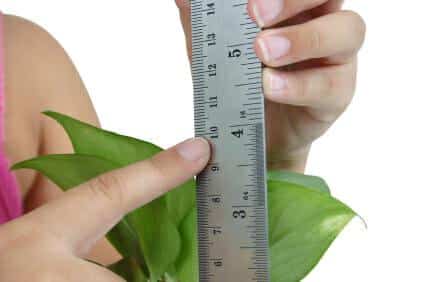
One of the greatest thing about homeschooling your children is that you get to take math out of the realm of the abstract and plant it firmly in the practical world. Math in school is often tough for children because they see few real examples of how people use it in real life. You have a great opportunity to make math more meaningful, and therefore, easier to learn.
Math can be applied to nearly any situation, but with spring around the corner, your mind is probably thinking about green things. Use your garden to introduce and reinforce math concepts. You can use the garden to teach concepts for your youngest and your older kids. There are countless ways to make math fun and useful.
Basic Math for the Youngsters
For your three to five year olds, use gardening to work on counting and numbers. Use plants or seeds to represent and teach numbers. Count the number of each type of plant and compare it to the total number of plants for a very basic lesson on fractions. Talk about how many plants are left when some die or are removed from the garden for simple subtraction problems. Count the fruits and vegetables as you harvest them. Use seeds to help a visual learner work on numbers. You can have your child arrange the seeds to do basic arithmetic.
For a simple project, have your child count and record the number of seeds that you plant. You can include the whole garden or just one type of plant depending on how involved you want to get with the project. When the seeds begin to sprout, your child can count and record the number and compare it to the number of seeds that you planted.
A Little More Advanced
You can use the above lessons for older children as well. Make them more complex by including all the plants in the garden and by using more advanced calculations. Teach your children about collecting data by having them record the number of seeds, the number of sprouts, and the numbers of flowers and fruits or vegetables that result from each plant.
Your older children could also benefit from turning the math lessons into garden planning. Talk about area and how much room each plant needs. Guide them through the process of planning the space for the garden and figuring out where each plant should go and how many you will need.
You can also introduce the concepts of multiplication and division when you talk about area. Have your kids draw pictures of the garden and discuss how you can count the number of plants using addition and multiplication. Return to the seeds to help make the operations more visual.
Measurement
Turn the garden into a lesson in measurements. Learning how to measure things properly and with the appropriate units is a practical skill as well as an important math lesson. Measure the sides of the garden and the rows using one unit. Ask your children to convert those measurements into several different units. Unlike being in classroom, they can actually check their work by hand. For instance, if they measure one side of the garden in feet, the can convert that into measurements in inches, meters, and yards and then check their calculations by re-measuring.
You can also have them make measurements to record and create an almanac. They can measure and record daily temperatures, humidity, wind speeds, rain fall, and time of sunset and sunrise. Make it an annual project and as the kids get older they can use their almanacs to make predictions and to learn statistics and probability. You could even get a Farmer’s Almanac so they can compare their measurements to it.
Algebra
Algebra can be one of the toughest parts of math to learn and to teach. It marks a transition between the basic operations and more complex types of math. The more you can make those letters and numbers apply to real world situations, the easier it will be for your children to grasp the concepts behind algebra. Instead of a generic x for a variable, use items in the garden to represent variables: c for corn, f for fencing, t for turnips, or s for seeds, for example.
Unless you are a math whiz yourself, it may be difficult to come up with a whole lot of algebra gardening problems. Use an algebra resource like a textbook or workbook to get some example problems. Translate them into gardening problems and change the variables to match your needs. After doing this a few times, you should find it easier to come up with original problems for your children to practice.
Geometry
A garden lends itself very well to learning geometry. You and your kids can measure the sides of the garden and the edges of the different plots and apply the numbers to geometry problems. Measure angles as well and then recreate the garden to scale on paper. You can create geometry problems and lessons using your garden as an example. Challenge your children to design gardens using certain parameters and measurements. This will help them learn geometry terms and ignite their creativity if you give them paper, markers, crayons, colored paper, and other art supplies to make their designs.
Budgeting
Budgeting is one of the most practical of all mathematical skills. Turn it into a fun project for your kids by asking them to plan a garden based on a budget. This can be very simple for younger children or more complex for your high school-aged kids. Give them a set amount of money to spend. They will need to research the cost of plants, seeds, equipment, and anything else they would need. For older kids, include another element to increase the complexity. Ask them to include plans for how much food your family will need from the garden and what types of plants will meet everyone’s nutritional needs within the budget.
Math lessons don’t have to be boring, and they certainly don’t have to be meaningless. Get your kids excited about working in the garden and learning math at the same time.