 Print
Seeding and cultivating are actually very simple processes. The reason for all the machinery is that in spite of being simple, it can be rather back-breaking and time-consuming work. In order to solve the problem of aching muscles and hours of work, machinery to do the hard work in less time evolved through the years.
 While many of the gas-consuming farming machines are too big for the average homesteader to use efficiently anyway, even backyard gardening has evolved to use motorized tillers and seeders pulled behind garden tractors.
For homesteaders, this creates a particular conundrum: how to do the same work with as little effort as possible, using time to the best advantage but without consuming expensive, damaging fuel to do it. Using fuel is bad for the environment, and it creates a dependency on the “system” that goes against the grain of most self-sufficient people.
The answer is to take a step back—in time that is. During the evolution of the heavy-duty machinery meant to dig the soil and plant the seeds, tools were created that fit the homesteaders needs today as well as they did a hundred years ago. These tools are still available today, and they do a good job to make the job of tilling and planting easier and faster than doing it completely by hand.
Choosing the Best Seeders
Seeders are pretty straightforward. Most small-acreage gardeners still use manual seeders because they are the best choice, less expensive, and easy to operate. Manual seeders come in two basic styles: broadcast and row seeders.
Broadcast seeders are best used for developing pastureland for livestock or grass areas for around the home. They employ a bin on wheels that holds a large quantity of seed that is scattered across a large area as it is rolled over the ground.
New Survival Seed Bank™ Let’s You Plant A Full Acre Crisis Garden!
Row seeders travel along a garden row planting individual seeds at a predetermined space and depth. Row seeders save the most work, because otherwise, you would have to bend down to place each individual seed, measuring the distance between seeds and the depth each seed is buried. Using a row seeder makes short work of a very tedious process.
A row seeder usually has a large wheel with a small seed bin attached to the back. At the bottom of the bin there is a seed plate that catches individual seeds as they drop from the bin while you roll along the row. These plates are interchangeable for distance between seeds as well as depth to plant each one.
The entire process is manual. The seed plate is turned by the rotation of the wheels as you push the seeder along the row. There is a knife edge in front of the seed spigot that drops the seed and can adjust to the depth required for planting. Behind each seed, a flat edge drags the dirt to cover the seed. Seeders can be purchased with single row, double row, triple row—all the way up to six row—capacities, and some can be adjusted to the rows needed for each individual planting.
Choosing the Best Cultivator
Cultivators are a little more involved but equally simple in their design. The entire idea behind cultivating is to dig up the ground, turn it, and make it loose. Cultivating is also used to remove over-growth from undeveloped ground, as well as removing weeds during the growing process.
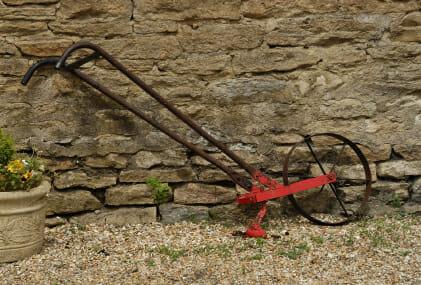
Generally, manual cultivators have a large wheel to make it easy to push over a wide variety of ground situations with two long handles on either side of the wheel for the operator to hold and push to propel the cultivator. Cultivators are usually made of either steel or wood. Both have their advantages, although wood is often the cheaper of the two types of cultivators.
Behind the wheel is a single attachment. This attachment area is where the differences in cultivators are the most prominent. Most cultivators allow for the interchange of attachments so one piece of equipment can do most or all of the cultivating work. Attachments for cultivators include:
- Plow: This is a large, flared wedge with the narrow edge pointed toward the wheel of the cultivator. It drags behind and breaks into thick, unbroken ground.
- Single Blade: This is a long, sharp blade that is attached to the cultivator vertically, with the sharp edge facing forward toward the wheel and a sharp, spiked end pointed down to the earth. As the cultivator moves, this spike is driven down into the already-broken soil to create rows.
- Multiple Tine Cultivator: This is a single attachment with three, four, or five tines jutting out behind it, each with a small spade-like tip to loosen up soil. It works like a rake along the ground and is used to loosen large patches of ground for pastures or to get rid of weeds on the surface of cultivated ground.
- Slicing Hoe: Also known as a scuffle hoe, this attachment looks like a stirrup with a long, flat blade at the bottom. The slicing hoe digs under rows to get rid of weeds deep in the soil before planting.
Of course, cultivating can also be done completely by hand, with long-handled hoes. These are available with all of the same types of heads as the attachments above and are very affordable. The difference is in the amount of exertion required versus letting the wheeled cultivator take the brunt of the burden when working with the earth.
©2012 Off the Grid News