 Print
Print
 The recent recall of a half billion eggs due to a salmonella scare is one more reminder of the need for safe, sustainable food production. It also raises the issue of just how far the government will go to control food production as a means to further its social engineering agenda and hold consumers hostage to its vision of “safe” food production. A Senate bill (S501) recently introduced under the guise of “food safety” is another example of the government’s desire to increase our dependence on government regulated food production.
With over 80% of our food produced by factory farms owned by large food conglomerates, we’ve become much more susceptible to the intervention of state-controlled food production. Layers of regulations and legislation will slowly erode any semblance of food independence. As production resources such as fossil fuels and genetic engineering become scarcer or are outlawed, our rulers will seize on the crisis to exert ever-more influence.
As this startling reality is recognized by the masses, more attention is being given to sustainable food production as a means to feed the population without being held hostage to government-controlled resources and disease-infested industrial farms. Spurred on by increasing consumer demand for healthier, organically grown foods, small farmers, collective farms and self-sufficient homesteads are perfecting permaculture methods introduced several decades ago.
Permaculture is based on an understanding of the ecological and biological principles of natural food growth cycles. It seeks to replicate nature’s patterns to maximize production while minimizing the use of non-renewable resources. The objective of permaculture practitioners is to shift dependence from technology-based farming to knowledge-based farming.
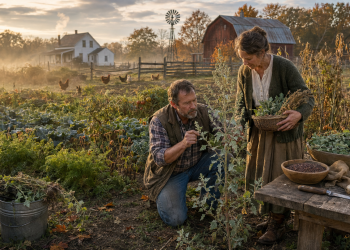
In practice, a farm or habitat is examined holistically for its naturally existing elements—plants, soils, climate—and then studied for the interrelationships between these elements and how they occur naturally. Plants or crops are grown in relation to one another and the natural benefits they can provide that will help sustain each other. Animals may be introduced into the design if they provide benefits to the growth cycle. For instance, chickens can aid the sustainable growth of plant foods by churning the soil and removing bugs. Additionally, chicken manure is a very good natural fertilizer.
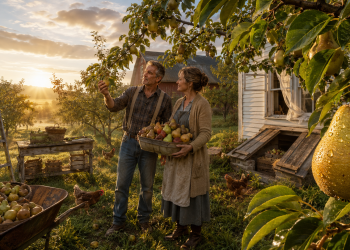
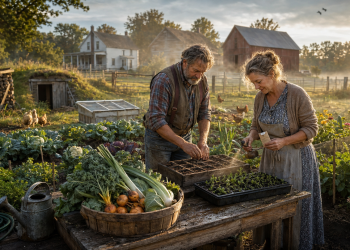
The long-term application of permaculture as a mass-production alternative is to be achieved by training more people in the basic design principles so that they can create their own self-sufficient farms and homesteads. Simple permaculture designs can be used in backyard gardens, on urban roof tops, and vacant neighborhood lots.
Grass farming, which employs a rotational livestock method, is another form of permaculture that is based on the eco-architectural design. Already a proven and profitable means of producing organic meats and eggs, grass farming is as a safe and sustainable source of food is growing in popularity
The design elements are different, but the same principles of interrelationships are applied to cattle farming in order to optimize the natural resources and reduce reliance upon technology. Grazing herds of cattle are directed to fresh pastures where they feed off the grass and leave their dung. They move on and are followed by poultry that then feed off of the freshly fallen grains and clean the dung of insect pests. The dung is left to fertilize the soil which then produces fresh, young grass. The herd cycles through several pastures until they return to the first one. Under the right conditions, that cycle can be sustained indefinitely.
The same design principles can be applied to chicken farms to produce healthy, organic eggs in a disease-free environment without the use of antibiotics. All farm animals have a role in the ecosystem where their natural propensities become a recyclable resource.
Because organic meat is produced with minimal technology and fuel, the farmers can turn a nice profit. They still command higher prices in the stores because of limited supply—there are just not enough producers to meet the demand.
If the current direction of factory-based, government-controlled food production continues on the path of more restrictions and tighter control over production resources, such as oil and new technology, food prices will rise and production will decrease. This will produce a food scarcity that will drive the masses to independent, sustainable food production…or disaster.
Other articles in this issue:
- Are We on Our Way to an Economic Calamity? We May not Know until it’s too Late
- A Tomato a Day Keeps You Healthy…and Full!
- Disaster Drills: The Best Preparation
If you liked this article you may be interested in this product from our sponsor.