 Print
Print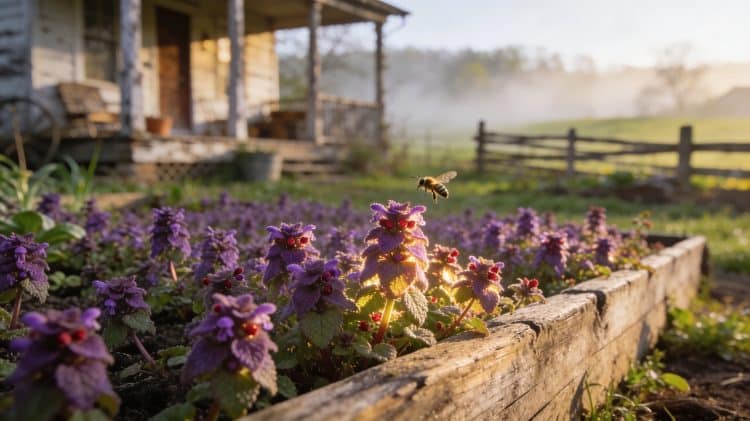
The Remarkable Plant You’ve Been Walking Past All Season
Chances are, it’s already growing right outside your back door — maybe creeping along the edge of your garden beds, poking up through the mulch around your chicken run, or carpeting that scraggly patch near your compost pile.
You’ve probably yanked it out more than once without a second thought. But that low-growing, purple-tinged little plant you’ve been tossing in the compost? It’s one of the most underrated medicinal and edible plants in North America, and it’s completely free for the taking.
It’s called purple dead nettle (Lamium purpureum), and once you know what it is, you’ll never look at your yard the same way again.
A Weed With Deep Roots in History

Purple dead nettle is an annual herbaceous plant originally native to Europe and Asia. It didn’t show up in North America on its own — it hitched a ride with European settlers, most likely as a contaminant tucked inside seed stocks, soil, and agricultural goods that crossed the Atlantic centuries ago.
As those early homesteaders broke new ground and cultivated the land, they inadvertently seeded a botanical ally that would quietly spread across the continent.
Today, it’s naturalized across much of the United States, thriving in the very kinds of places homesteaders know best: disturbed soil, tilled fields, garden edges, and roadsides. It got the name “dead nettle” because it looks a whole lot like stinging nettle at first glance — but here’s the good news: it doesn’t sting a bit.
How to Know What You’re Looking At
Purple dead nettle is a member of the mint family, and like most mints, it’s got the telltale square stem. The leaves are heart-shaped or spade-shaped, softly fuzzy to the touch, and green toward the base of the plant.
As you move up toward the top, those leaves shift into a rich, dusty purple — which is exactly where the name comes from. The flowers are tiny, bright reddish-purple blooms with a hooded upper petal and a divided lower lip that almost looks like a little open mouth. They can appear as early as late winter in milder climates, pushing up right through the melting snow of early spring.
The whole plant typically stays low, running anywhere from two to eight inches tall, often spreading out as a dense ground cover in patches of well-drained, nitrogen-rich soil — like the dirt around your chicken pen or a recently turned garden bed. If that description sounds like half your property, that’s because it probably is.
Don’t Mistake It for Its Neighbors
Out in the field, purple dead nettle is most often found shoulder-to-shoulder with henbit (Lamium amplexicaule), its closest lookalike.
Both plants have similar leaf shapes and purple flowers, and they’re easy to mix up — but here’s the key difference: purple dead nettle’s upper leaves are stalked, while henbit’s upper leaves wrap directly around the stem without a stalk. Purple dead nettle also tends to grow taller, with longer, more dramatic stems capped by that signature cluster of purple-tinged leaves.
You might also run across creeping charlie (also called ground ivy), which shares the purple flower and minty smell. And woolly mint or catnip could fool you at a distance, but they’ve got much stronger, distinctive scents compared to dead nettle’s earthy, grassy aroma. The reassuring thing?
Most of its lookalikes are edible anyway. But knowing exactly what you’re eating is always worth the extra minute of attention.
A Wild Superfood from the Garden Weeds
Here’s where it gets genuinely exciting for anyone trying to stretch their homestead pantry or boost their family’s nutrition without a trip to the health food store.
Purple dead nettle isn’t just edible — it’s a nutritional heavyweight. It’s a solid source of vitamin C, vitamin A, iron, magnesium, and potassium, and like most wild-foraged greens, it tends to be more nutrient-dense than anything you’ll find in a grocery store produce section.
The young leaves and tops are the most tender and mild-flavored — somewhere between spinach and lettuce, with a hint of earthiness that’s easy to appreciate once you get used to it. Toss a handful into your scrambled eggs on a spring morning, fold it into a salve, blend it into a pesto, or chop it fine and throw it into tacos in place of cilantro.
It dehydrates beautifully and can be powdered right into a custom smoothie green blend alongside other foraged or garden herbs. On its own, the flavor is pretty herbal and grassy and the fuzzy leaves aren’t for everyone’s palate raw — but mixed into dishes, it disappears right in and delivers real nutrition.
The Medicine Cabinet That Grows in Your Yard
Beyond the kitchen, purple dead nettle has been used in herbal traditions for centuries as a legitimate first-aid plant.
Herbalists classify it as astringent, diuretic, diaphoretic, and purgative — meaning it helps tighten tissue, promote urination, encourage sweating during illness, and support gentle cleansing of the gut. On top of all that, it’s anti-inflammatory, antibacterial, and antifungal.
Fresh leaves can be applied directly to cuts and scrapes as a poultice — think of it like yarrow or plantain, two plants that homesteaders have depended on for generations. For a more concentrated preparation, it can be made into a tincture said to support pain relief and reduce inflammation, or simmered into an infused oil and worked into a salve for irritated, itchy, or sore skin.
A simple tea brewed from fresh or dried leaves may also support kidney health and offer some relief during allergy season — though it’s worth noting that large quantities can have a laxative effect, so start slow. If you’ve ever wished your land would just grow its own medicine cabinet, here’s proof that in many ways, it already does.
One More Trick: Natural Dye for the Fiber Homesteader
If you keep sheep, raise fiber animals, or do any spinning and weaving, here’s a bonus you might not expect from a so-called weed.
Purple dead nettle can be simmered down into a natural dye bath that produces a soft, pale green color on wool and yarn — especially when an iron modifier like ferrous sulfate is added to the dye pot.
Two to three gallons of fresh plant material, a mordanted skein of wool, and a slow simmer is all it takes to pull a lovely sage green straight from your pasture.
Let It Grow — At Least for a Little While
Before you fire up the mower this spring, take a walk around your place and look for those low purple patches hugging the ground.
Because purple dead nettle is one of the very first plants to flower each year, it’s a critical early food source for native pollinators and honeybees at a time when almost nothing else is blooming. Bees will choose it over dandelion, working the tiny blooms for both nectar and that precious floral protein they need to build up their hives after winter.
Holding off on mowing even for a few extra weeks can make a real difference for your local pollinator population — and meanwhile, you’ve got a free harvest of edible greens, herbal medicine, and natural dye sitting right there in the yard.
That “weed” you’ve been fighting? It’s been waiting to be your ally all along.
As with all wild plants, proper identification is essential before consuming or using any foraged material medicinally. Consult a qualified herbalist or physician before using herbal preparations, especially if pregnant, nursing, or managing a health condition.