 Print
Print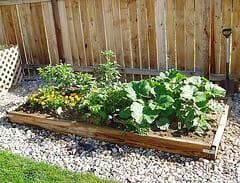
 Gardening in raised beds has been used for many years in places where the native soil is poor either due to a lack of nutrients or because of rocks and other obstructions – such as tree roots. They can be built from just about anything – rocks, wood, concrete blocks, bricks or even hay bales. Most gardeners usually go with what is available or less expensive.
I built my beds with untreated wood and deck screws on my back patio with no outside help. I built six boxes 7.5’ x 4.5’ and 12” deep – no bottoms and easy drainage. I completed my boxes in two Saturday afternoons. My friend Betty built an oval bed using the rock that was on her property. They piled the rock in a dry stack wall about 12” high to surround the area they wanted to grow in. Then they filled it in with dirt and compost and planted strawberries in it. If they could keep their chickens out of it, they would have nice, plump berries all summer long.
Square Foot Gardening
Mel Bartholomew popularized “square foot” gardening in 1981. He wrote a book on this method that was published by Rodale Press and also had a PBS show teaching his methods.
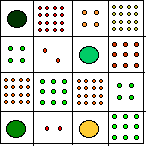
A basic for this type of gardening is to build your bottomless boxes in a size easily reached across by the gardener – usually 2’ to 4’ squares. Fill them with a mixture of equal parts topsoil, peat moss and compost or manure. Divide your boxes into 1-foot sections with twine or cheap, unfinished molding strips and tacks – I used unpolished hemp twine and tacks to divide my boxes. The hemp holds up well and can be added to your compost pile when the season is finished.
In each section you would grow 1 large plant (tomatoes); two medium- large plants (peppers); four medium plants (lettuces or herbs); and nine small plants (carrots, garlic or onions). Radishes can be grown at 16 per square foot. Fruits and vegetables that are tall or that climb should be planted on a southern side of the garden to avoid shading the other plants. Vines, like melons or squashes can be trained to climb a frame strung with netting or string, or on trellises. Different squares would grow different things and those vegetables with short seasons can be planted more than once in a season – carrots, lettuces and greens [spinach, kale, mustard, etc]. When a square is harvested, then a new and different crop is grown in that square.
In this type of gardening there is much less maintenance, it saves water, and with companion planting, can be almost pest free. If insects do present themselves, they are easily managed as there are only a few plants of any variety in one area, and organic pesticides are available to rid yourself of them quickly.
Lasagna Gardens
A lasagna garden is considered a “no-dig,” “no till” garden. The name of this process is due to how they resemble that tasty Italian dish. The ingredients for a “lasagna” garden are as follows:
- Grass clippings
- Leaves
- Fruit and vegetable scraps
- Coffee grounds and filters
- Tea leaves and tea bags
- Weeds, if not gone to seed
- Manure
- Compost
- Seaweed
- Shredded newspaper or junk mail
- Pine needles
- Spent blooms and garden trimmings
- Peat moss
- Anything else that you may put into your compost pile
Just like making a lasagna dinner, when you put your lasagna garden together there is an order to putting down your layers – alternate your “browns” (fall leaves, shredded newspaper, peat, and pine needles) with your “greens” (vegetable scraps, garden trimmings, and grass clippings). Your brown layers should be about twice as deep as your green layers and you start with a green layer. For keeping weeds out, first lay out a layer of newspaper pages (not shredded), water well before adding the green layer, continue alternating layers, and finish with a brown layer. Don’t be afraid if the ratio isn’t exactly right. Just keep alternating your browns and your greens and a lasagna garden will happen.
While building my garden I found that there was something in our native soil that I was allergic to so I had to build a hypoallergenic soil to grow my garden. I used a combination of the lasagna method and the square foot method to build up my beds and row my garden. I knew that if it was something that I could eat or have in my home, than I would not be allergic to the soil when it was all broken down in my garden beds. Don’t be afraid to experiment! This is how great inventions and discoveries are made.
So build a bed, choose a style, buy some seed and grow, grow, grow!