 Print
Print
Why A “Mild” Winter Can Punish Pipes, Roads, Solar Panels And Power Systems
Forecasters See A Historic El Niño And A Milder Northern Winter… But The Winter That Doesn’t Look Dangerous May Be The One That Finds Every Weak Spot On Your Homestead
“The horse is prepared for the day of battle, but victory belongs to the Lord.” — Proverbs 21:31
Every September, you can almost write the winter headlines before they show up: Brutal Winter Coming. Stock More Firewood. Prepare For The Deep Freeze. Most years, that advice is close enough to useful that nobody thinks much about it.
You stack another row of oak behind the barn, put a fresh plug in the generator, check the propane gauge and figure Old Man Winter will eventually come rattling down the driveway. But this year, the signals are pointing somewhere else — and strangely enough, that may create a different kind of trouble.
Because if you prepare for the winter you’re expecting instead of the winter that actually shows up, you could spend February crawling underneath the house with a flashlight, replacing busted fittings, dragging feed through knee-deep mud and wondering why nobody warned you.
The Pacific Is Doing Something Big
Right now, the biggest winter story is happening thousands of miles from your woodpile.
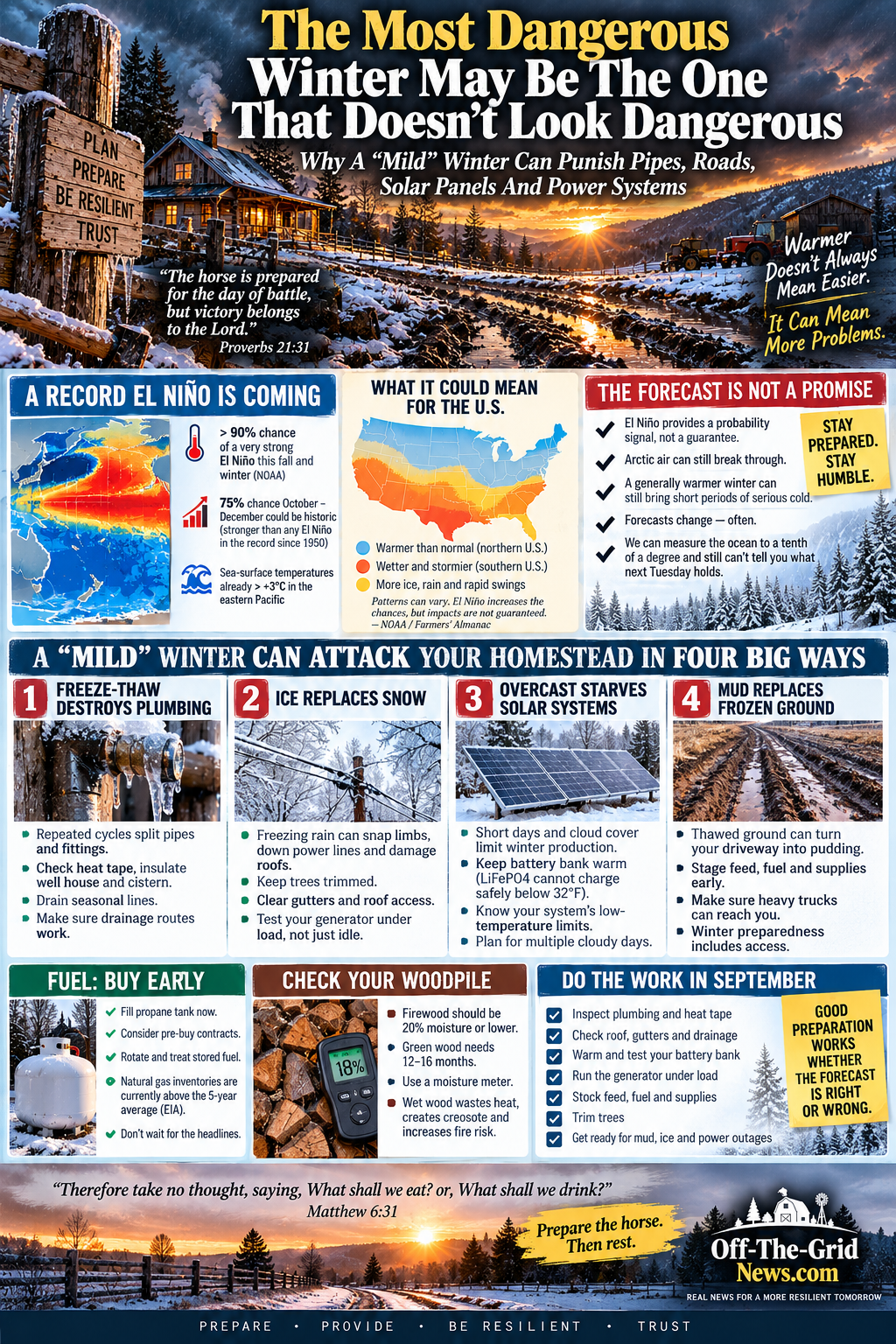
NOAA’s Climate Prediction Center issued an El Niño Advisory on September 10 and says El Niño is strengthening rapidly. The agency now puts the probability of a very strong El Niño above 90% for the fall and winter of 2026–27.
Even more remarkable, NOAA puts the odds at 75% that the October–December period reaches historic strength, exceeding previous El Niño events in its record going back to 1950. Sea-surface temperature anomalies have already exceeded +3°C in portions of the eastern equatorial Pacific, while the closely watched Niño-3.4 region reached +1.8°C in August.
That’s not some tiny wiggle on a thermometer. That’s a tremendous amount of heat sitting in the Pacific Ocean, interacting with the atmosphere and potentially shifting storm tracks thousands of miles away.
The broad historical pattern is well known. NOAA explains that El Niño can alter the jet stream and change temperature and precipitation patterns across North America, although the exact outcome varies from one event to another.
Generally speaking, strong El Niño winters tend to favor a more active southern storm track, while parts of the northern United States can lean warmer. The Farmers’ Almanac 2026–27 outlook likewise describes an active southern storm track coupled with quick northern cold snaps, snow squalls and milder breaks.
Notice the word tend.
That word matters.
“Mild” Doesn’t Mean You Can Put The Snow Shovel Away
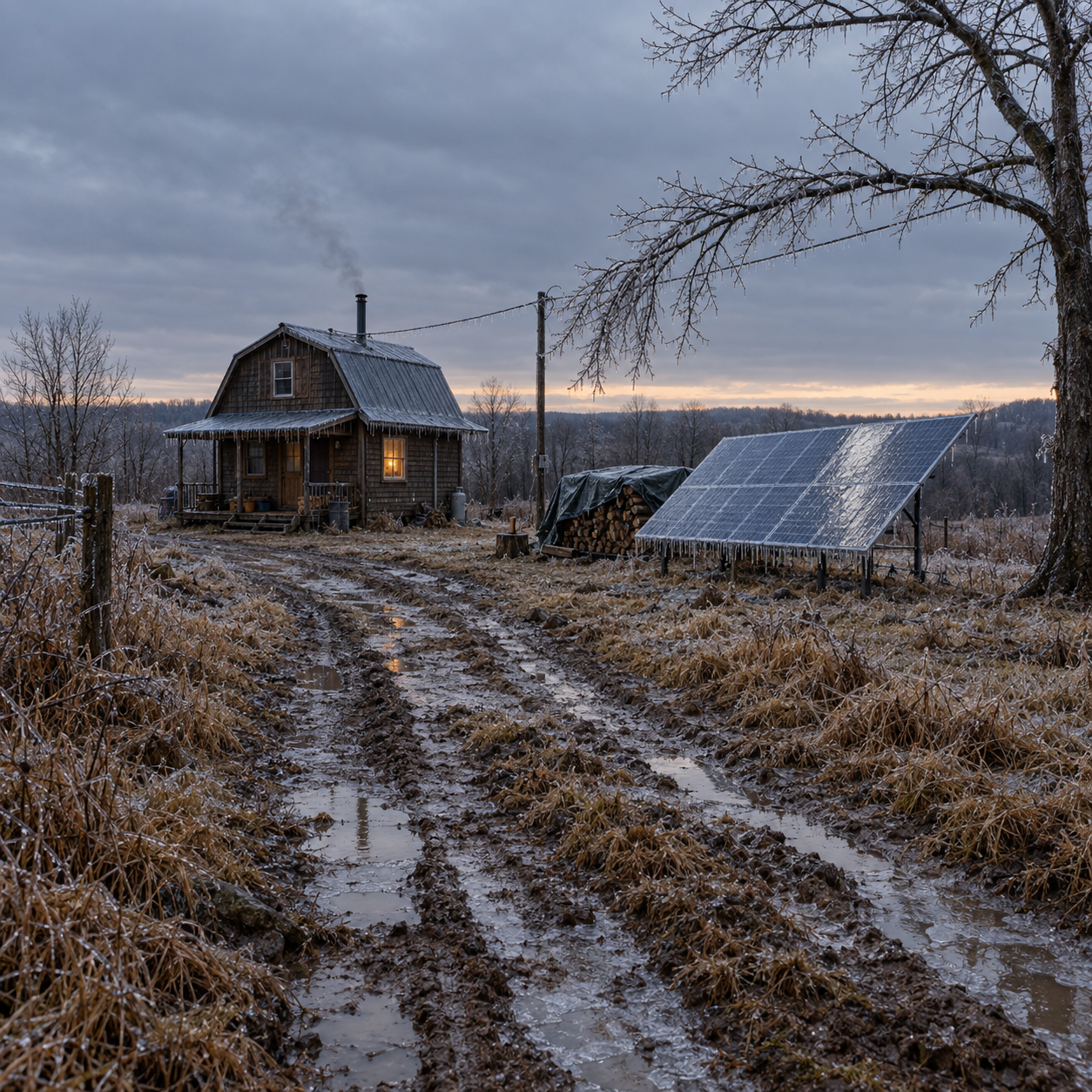
The Farmers’ Almanac is painting a particularly interesting picture for the northern half of the country. Its forecast calls for sharp contrasts rather than one long stretch of bitter weather: milder periods interrupted by quick cold snaps, blowing snow, sleet and sudden changes.
For the Great Lakes and Midwest — including Illinois and Wisconsin — its outlook calls for temperatures averaging near normal overall but with sudden snow squalls, blustery winds and bursts of bitter cold frequently interrupted by milder breaks. Across the middle of the country, the Almanac specifically warns of repeated swings between thawing and freezing.
And for an off-grid homestead, that kind of winter can be more aggravating than simply staying cold.
When January locks the farm at 15 degrees and leaves it there, you know what you’re dealing with. The ground freezes hard, the driveway firms up, snow stays snow and the plumbing remains in the same basic thermal environment day after day.
But give me 39 degrees and rain on Tuesday, 18 degrees Wednesday night, 42 degrees Friday afternoon and another freeze Saturday morning, and suddenly the farm starts moving underneath you.
Things expand.
Things contract.
Water runs somewhere it didn’t run last week.
Mud appears where solid ground used to be.
Then everything freezes again.
That’s when things start breaking.
Here’s The Part The Forecast Articles Usually Bury
Long-range weather forecasts are not promises, and NOAA itself says so. While an El Niño of this magnitude increases the chances of impacts normally associated with El Niño, the agency specifically cautions that those impacts are “not guaranteed.”
The Farmers’ Almanac makes essentially the same point in its 2026–27 winter outlook. El Niño supplies a broad probability signal, but Arctic air can still punch southward when atmospheric patterns line up correctly, meaning a generally warmer pattern can still produce short stretches of serious cold.
That’s worth remembering, because man has satellites circling the planet, buoys bobbing across the Pacific, weather balloons climbing through the atmosphere and supercomputers chewing through mountains of data. We can measure the Pacific Ocean to fractions of a degree and still can’t tell you exactly what the weather over your barn will be six weeks from Tuesday.
Job 38 puts the question rather beautifully:
“Hast thou entered into the treasures of the snow?”
Then Job 37:6 reminds us:
“For he saith to the snow, Be thou on the earth.”
That doesn’t mean Christians throw away the weather radio and stare at the clouds. It means we remember who’s who.
Prepare Like The Ant — Then Quit Pretending You’re God
Scripture never treats preparation and trust as opposites. In fact, Proverbs points us straight toward one of the smallest preparedness experts on the homestead:
“Go to the ant, thou sluggard; consider her ways, and be wise: Which having no guide, overseer, or ruler, provideth her meat in the summer, and gathereth her food in the harvest.” — Proverbs 6:6–8
That’s preparedness. Stack the wood, fill the tank, store the feed, insulate the pipes and fix the roof while the September sun is still warm enough that your fingers work.
But Scripture gives us the other side of the equation, too:
“A man’s heart deviseth his way: but the Lord directeth his steps.” — Proverbs 16:9
So prepare thoroughly — and hold the forecast loosely.
The outcome was never yours to secure.
Why A “Mild” Winter Can Beat An Off-Grid Homestead To Pieces
Here’s where all of this gets practical. A brutally cold winter gets everybody’s attention, while a swinging winter can quietly attack the homestead from several directions at once.
Worse, you often don’t notice the damage until something quits working.
Problem #1: Freeze… Thaw… Freeze… Thaw
Water is patient. Give winter enough opportunities to move water into vulnerable spaces, followed by enough hard freezes, and sooner or later you’re going to discover the weak spot you forgot about last summer.
That’s why now is the time to crawl through the ugly places. Check the heat tape, inspect the crawl space, wrap exposed plumbing, insulate the well house and cistern, and drain seasonal outbuilding lines instead of trusting a marginal heater to protect them all winter.
And while you’re down there, look at drainage. Repeated winter thaws can send runoff into low spots, around foundations and across driveways that remain frozen solid during a more consistently cold winter.
The water has to go somewhere.
Make sure you decide where before winter decides for you.
Problem #2: Snow Can Turn Into Something Nastier
I’d rather shovel eight inches of powder than deal with half an inch of freezing rain. Snow mostly sits there; ice starts pulling things apart.
Tree limbs bow, power lines sag, walking becomes dangerous, roof valleys clog and gutters freeze solid. Solar panels can turn into glazed-over sheets of glass at precisely the time you desperately need every watt of winter sunlight you can collect.
The Farmers’ Almanac winter outlook specifically warns that temperatures hovering near freezing can make precipitation type especially difficult to predict. A tiny temperature change can turn cold rain into an icy mix or a harmless-looking slushy snowfall into something much more troublesome.
So look up while the leaves are still falling. Trim questionable limbs before they’re carrying hundreds of pounds of ice over your roof, driveway, solar equipment or power line, and make sure gutters and drainage paths are clear.
Then start the generator.
Don’t just listen to it idle behind the barn for five minutes and congratulate yourself.
Put a load on it.
A generator that happily coughs away with nothing attached isn’t necessarily a generator ready to carry your refrigerator, freezer, well pump and heating equipment at 2:00 in the morning when ice is cracking tree limbs outside.
Problem #3: December Clouds Can Starve A Solar System
Solar panels themselves generally perform efficiently in cold temperatures, but winter brings another problem: short days, low sun angles, snow and potentially long stretches of cloud cover. The U.S. Department of Energy explains that solar output depends on the amount of sunlight reaching the photovoltaic cells, which is exactly the resource winter gives you less of.
Three gray days in a row can turn a perfectly adequate July solar system into an energy-rationing exercise. That’s especially important if you’re running an electric well pump, freezers, livestock equipment or other loads that don’t care whether the sun came out today.
Then there’s lithium.
If you’re running LiFePO4 batteries in an unheated shed, know the charging specifications of your particular batteries and battery-management system. Many lithium iron phosphate batteries restrict charging at or below freezing because low-temperature charging can damage the cells unless the system has appropriate protection or heating.
Don’t discover that during a January ice storm.
Insulate or condition the battery space where appropriate, verify your battery-management system’s low-temperature cutoff and test whatever supplemental heat you’ve installed. More importantly, calculate how many cloudy winter days your battery bank can actually carry the loads you consider essential.
Hope is not an amp-hour.
Problem #4: Your Driveway Turns Into Pudding
Here’s one city folks rarely think about. Frozen dirt makes a pretty good road; thawed dirt doesn’t.
If you’ve got a quarter-mile lane leading back to the house, barn or cabin, repeated freeze-thaw cycles can turn winter into mud season every other week. Now imagine the propane truck trying to get in — or the feed truck, septic truck or you trying to drag a loaded trailer uphill.
That’s why heavy supplies should arrive before the weather gets ugly. Feed, fuel, livestock bedding, salt, spare parts and anything else requiring a heavy truck ought to be staged while the driveway is still trustworthy.
Winter preparedness isn’t just about surviving cold.
Sometimes it’s about making sure the truck can reach you.
The Fuel Decision I’d Make Before The Headlines Start
Whatever winter ultimately does, don’t wait until everybody else gets nervous to think about fuel. Check the propane tank now, talk to your supplier about pre-buy or price-lock programs if they’re offered, and make sure stored gasoline and diesel are rotated and handled properly.
The U.S. Energy Information Administration updates its Short-Term Energy Outlook monthly, while its Heating Oil and Propane Update tracks residential heating-fuel markets during heating season. Those are worth watching if you’re trying to understand what the fuel market is doing, but don’t confuse watching prices with preparedness.
You’re not running a hedge fund.
You’re trying to keep the house warm.
There is tremendous peace in looking at a full tank before the first freezing rain starts ticking against the kitchen window.
And That Woodpile? Stick A Meter In It
Here’s another uncomfortable truth: your firewood may not be as dry as you think.
The EPA recommends burning seasoned firewood below 20% moisture. Its guidance recommends seasoning softwoods for roughly six months and hardwoods for at least a year, with the wood split, stacked off the ground and protected from rain while still allowing airflow.
Wet wood wastes heat, creates more smoke and contributes to creosote accumulation. According to the EPA’s wood-burning guidance, properly dried firewood should read about 20% moisture or less.
And you can’t reliably judge that by staring at the bark.
Buy a moisture meter. Split a representative piece and check the freshly exposed interior instead of simply touching the weathered outside and declaring it dry.
You may discover that beautiful stack behind the shed isn’t stove-ready yet. Better to learn that on a warm September afternoon than during a windy January night when the stove won’t burn properly and the chimney is collecting creosote.
The Best Winter Plan Works Even When The Forecast Doesn’t
That’s really the lesson here. The best preparations don’t require NOAA to nail the forecast.
Insulated pipes help during a brutal winter and a mild one. Dry firewood works at 10 degrees or 35, while a maintained generator doesn’t care whether the outage came from a blizzard, freezing rain or somebody’s maple tree landing across the line.
A protected battery bank works whether El Niño behaves exactly like the historical averages or does something meteorologists didn’t expect. And a full fuel tank never complained because the forecast changed.
That’s what good preparedness looks like.
You’re not betting everything on one prediction.
You’re building margin.
So Do The Work While The Sun Is Warm
September is merciful. The crawl space isn’t frozen yet, the roof isn’t covered in ice and your fingers still work without gloves.
The generator starts without fighting January temperatures, and you can split wood without wondering whether frostbite is settling into your ears. So use the window: crawl through the well house, meter the wood, protect the battery bank, fill the tank, walk the roofline, clear drainage, stage feed and run the generator under load.
Then, when you’ve done what prudence requires, quit carrying December around in your head.
The models will change and forecasts will be revised. Some predictions will prove remarkably accurate while others will miss badly, and winter will eventually come across the fields however it comes — snow, rain, mud, ice, bitter cold or some aggravating mixture of all five.
That’s where the homesteader ought to remember the difference between preparation and fear.
Jesus said:
“Therefore take no thought, saying, What shall we eat? or, What shall we drink?” — Matthew 6:31
Christ wasn’t condemning a full pantry or a stacked woodshed, and He certainly wasn’t condemning the fellow who fixes the well pump before January. He was warning about anxiety — that peculiar human habit of mentally living through tomorrow’s trouble before tomorrow ever arrives.
So stack the wood, fill the tank, fix the pipes and test the generator.
Prepare the horse for the day of battle.
Then sleep.
Because after you’ve filled your own little woodshed, you can trust the One who fills “the treasures of the snow.”