 Print
Print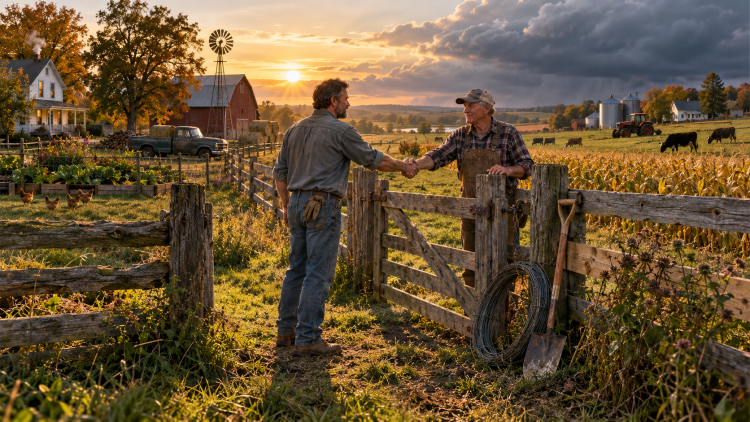
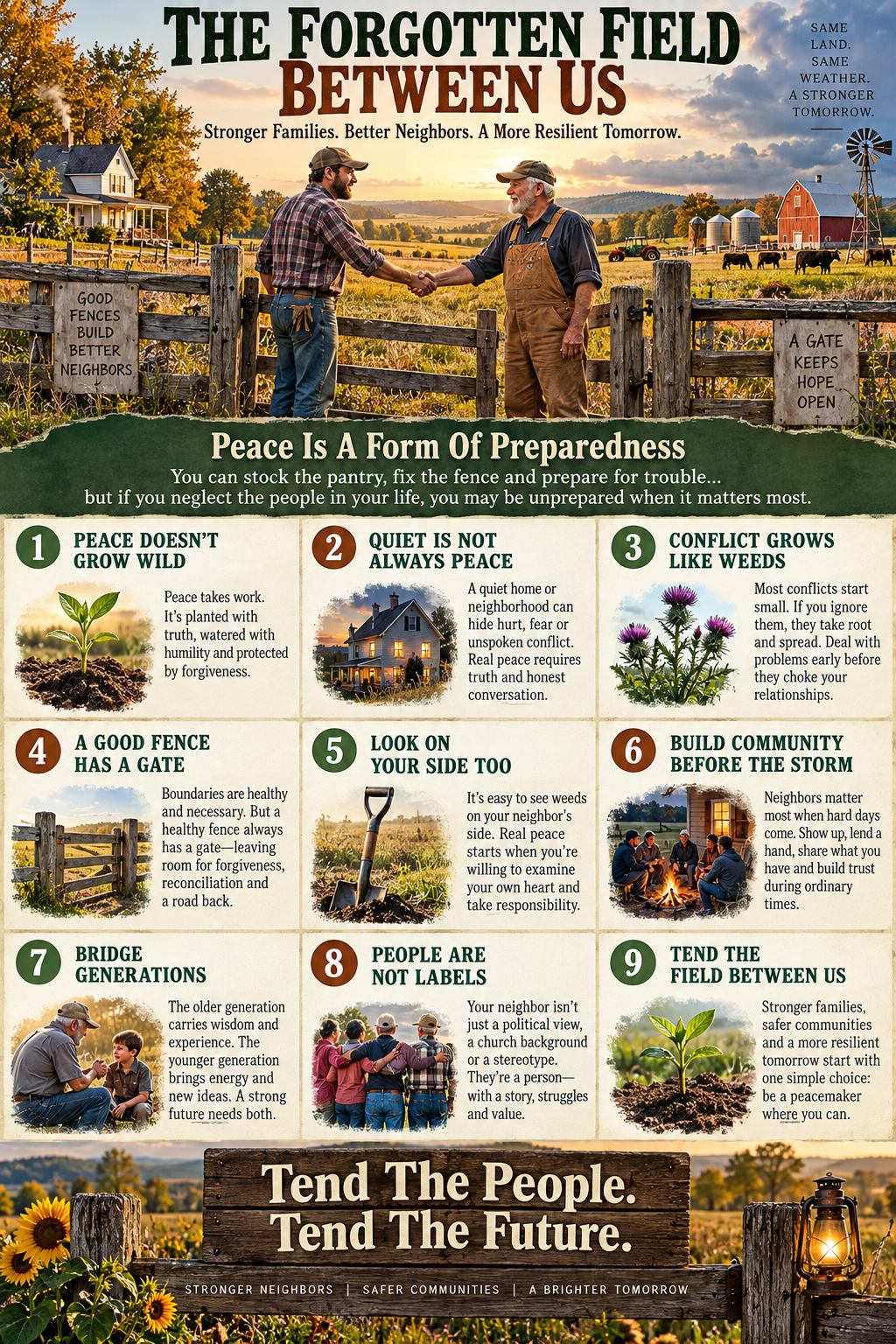
The Forgotten Form Of Preparedness You Can’t Buy… Store In A Basement… Or Order Online
The Forgotten Field Every Homesteader Has To Tend
Alright, stand again in the middle of your property one more time. Behind you lies the field of inheritance, where old family habits, inherited wounds, hard-earned virtues and unfinished work still shape the soil beneath your boots.
Ahead lies the field of possibility. That’s where you plant for tomorrow, build things for people you may never meet and decide what kind of household—and what kind of legacy—you intend to leave behind.
To one side lies the inner field, the private ground where you guard your thoughts, test your motives, pray, repent and wrestle honestly with what you really believe. To the other side lies the outer field, where those beliefs finally put on work boots and become visible… in gardens, homes, churches, businesses, friendships, neighborhoods and acts of service.
But there is another piece of ground every homesteader eventually has to learn to work.
It is the field between us.
This is the field of peace… the ground stretching between husbands and wives, parents and children, brothers and sisters, neighbors and neighbors, church members and church members, old-timers and newcomers. It’s where people learn to live together… or slowly become enemies separated by fences, grudges and years of silence.
And that field won’t tend itself.
Peace Doesn’t Grow Wild
A lot of folks seem to think peace is the natural condition of life. They imagine that if everybody would just calm down, be nice, avoid difficult subjects and mind their own business, peace would somehow sprout like clover after a spring rain.
But anybody who has spent enough years inside a marriage, a family, a small church or a rural community knows better. Put different people with different histories, fears, loyalties, interests, and personalities close enough together, and sooner or later sparks will fly.
Peace does not happen by accident. Peace has to be made.
Jesus didn’t say, “Blessed are the people who never have disagreements.” He said, “Blessed are the peacemakers”.
There’s a world of difference between the two. Conflict comes easily, while peace requires deliberate work… something strong enough to bring two different worlds together without pretending their differences aren’t real.
And these days, online and off, that may be one of the most important crops we can grow.
Peace Is Not The Same Thing As Quiet
A pasture can look mighty peaceful from the county road, right? The grass is green, the fence is standing straight, and the cows are scattered beneath the shade trees, tails lazily swatting flies.
But walk through the gate and take a closer look, and you might find a broken water line soaking the ground behind the trough, a calf standing off by itself or a fallen limb that mashed down twenty feet of fence. From fifty yards away everything looked fine, but up close you realize there’s work to do.
Quiet is not always peace.
The same thing happens inside a family. A house can be quiet because everybody is tired, but it can also be quiet because the children are afraid to speak, because a husband and wife have stopped talking about the real problem, or because somebody finally decided silence hurts less than another argument.
That isn’t necessarily peace. Sometimes it’s just a ceasefire, because real peace has more substance than the absence of yelling.
Real peace requires truth and humility, boundaries and forgiveness. Sooner or later, it also usually requires somebody willing to take the first uncomfortable step.
That might mean sitting across the kitchen table from your spouse and saying, “We can’t keep living this way.” It might mean calling the brother you haven’t spoken to in three years, swallowing your pride and admitting you were wrong, or walking across the property line after an argument about dogs, livestock, noise, politics, or a fence that’s three feet from where somebody thinks it ought to be.
Sometimes it simply means taking responsibility before a little crack becomes a busted foundation. A homestead doesn’t stay functional because nothing ever breaks; it stays functional because somebody notices what’s broken and fixes it before the damage spreads.
The field between us works exactly the same way.
Conflict Grows Like Weeds
Here’s the thing: Most serious conflicts don’t begin as giant disasters. They start small… a careless word, a favor never returned, a fence line moved a few feet, a complaint whispered behind someone’s back, a child disciplined in anger or a promise somebody conveniently forgot.
Maybe it’s a spouse who feels invisible or a church member who quietly feels pushed aside. At first, doing nothing seems easier, so we tell ourselves, “It’s not worth making a fuss over.”
And sometimes that’s exactly right. Not every irritation needs a family summit meeting, a confrontation or a Facebook manifesto, because mature people learn how to overlook small offenses.
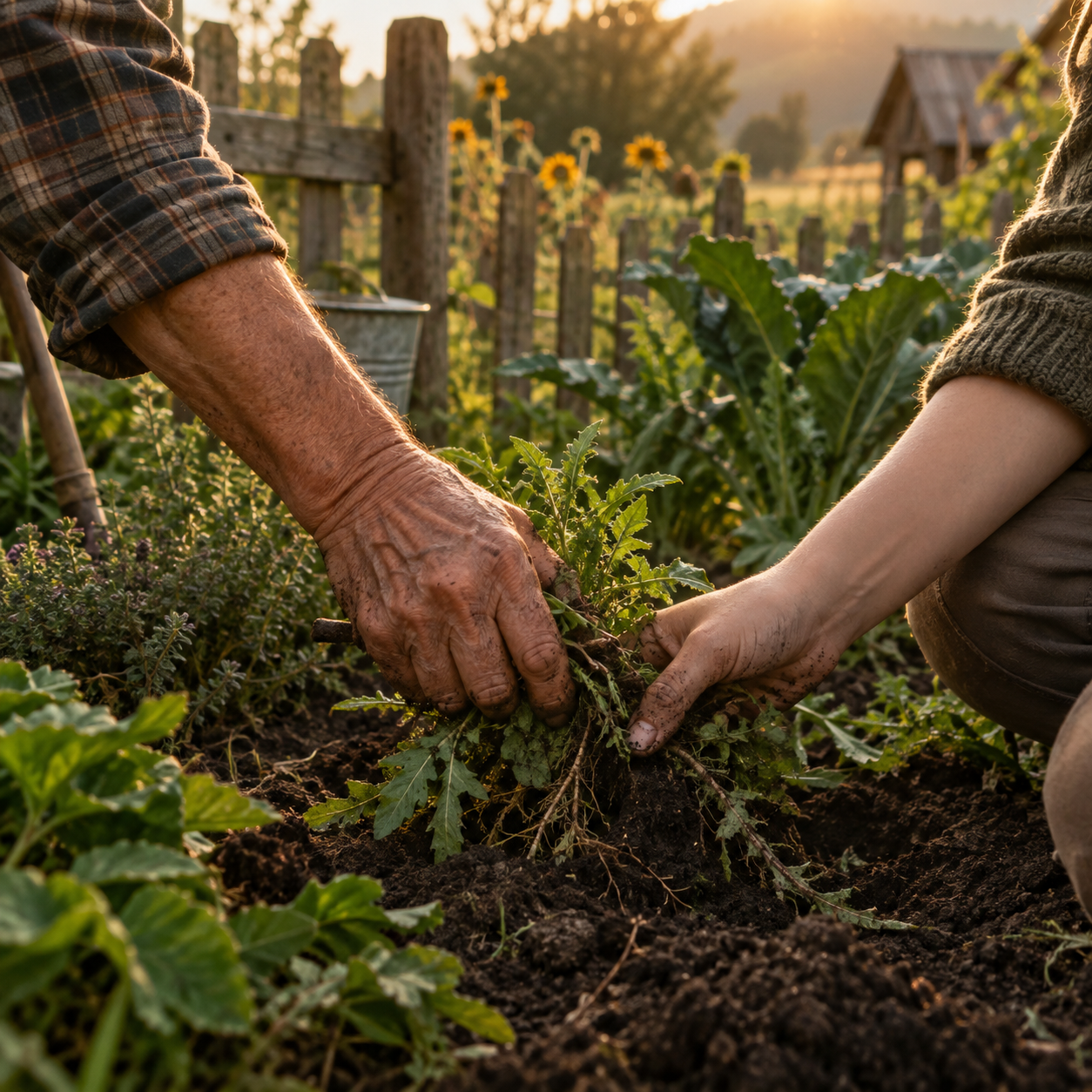
But some problems aren’t small, and the longer you leave them alone, the deeper the roots go. Anybody who has fought thistle, multiflora rose, poison ivy, kudzu or invasive grass understands the principle.
You don’t stare at the first patch all summer and wait until it owns half the pasture before deciding maybe you ought to do something about it. You get after it while you can still get a shovel underneath it.
Resentment works the same way… it spreads underground before you see much above the surface.
Pretty soon, you don’t merely dislike what somebody did; you’ve constructed an entire story about why they did it. You assume motives, replay conversations, avoid contact and quietly collect evidence proving that everything you’ve decided about that person must be true.
Before long, that neighbor, relative, spouse or church member isn’t simply a difficult human being anymore. In your mind, they’ve become the enemy… and that’s when the field between us starts looking less like a pasture and more like a battlefield.
Peace Requires Something Deeper Than An Agreement
Two people can settle a practical disagreement and still have no real peace. They can agree where the property line runs, how much money is owed, who works which shift or what rules everybody is expected to follow.
Those agreements matter, and clear expectations can prevent a truckload of unnecessary trouble. But paperwork alone cannot produce peace because peace requires something deeper… a shared spirit.
That doesn’t mean everybody needs the same personality, politics, background, church history, income, education or way of doing things. If peace required sameness, we’d all be in trouble.
Instead, it means recognizing that the person across the fence isn’t merely an obstacle standing between you and what you want. He’s more than “the neighbor with the loud dog,” and she’s more than “that difficult woman at church.”
He’s more than “the relative who votes wrong,” and she is more than “the person who hurt me.” They’re human beings made in the image of God, carrying burdens you cannot see, wrestling with fears you may never understand and living a story that didn’t begin the day they irritated you.
Peace asks us to step, however briefly, into another person’s frame of reference. It asks us to understand that another man’s mind, responsibilities, history and fears may be very different from our own while still belonging to the same human story.
That’s hard work, which is why labels are so much easier: liberal, conservative, city people, country people, rich, poor, educated, ignorant, outsider, insider—“one of those people.”
Once you’ve stuffed somebody neatly into a box, you don’t have to listen anymore. You don’t have to understand them, and you certainly don’t have to love them.
But the field between us cannot be healed with labels. Sometimes healing begins when we learn to see a person again.
A Good Fence Has A Gate
Homesteaders understand fences. A good fence protects the garden from livestock, keeps cattle out of the highway and gives each pasture a purpose.
Fences create boundaries, and good boundaries create order. But anybody who has lived in the country long enough has also seen fences that mean something else entirely.
Two properties may be separated by a perfectly ordinary woven-wire fence, but everybody within five miles knows what that fence really means: “Don’t come over here. We don’t speak. And don’t ask what started it, because this feud is older than the tractor.”
Relationships develop the same kind of fences. Now, boundaries are good, and sometimes they’re absolutely necessary.
Nobody makes genuine peace by allowing abuse, manipulation, theft, addiction, betrayal or cruelty to continue without challenge. Peace isn’t surrender, and it certainly isn’t pretending evil is good just because confrontation makes everybody uncomfortable.
But boundaries should protect life, not bury it. In fact…
A healthy fence has a gate.
A healthy relationship should have some possibility of a road back too. Sometimes that gate needs to stay shut for a season, sometimes trust has to be rebuilt board by board, and sometimes reconciliation cannot happen safely without genuine repentance, accountability and change.
But if every fence eventually becomes a permanent wall, you may wake up one morning sitting on a mighty impressive piece of ground with nobody left to call when the storm rolls in.
The question isn’t whether you need boundaries.
The question is whether those boundaries are serving wisdom… or feeding bitterness.
The Hardest Weed To Spot Is The One On Your Side Of The Fence
One of the hardest things in life is learning to see ourselves in the people we oppose. Most of us can spot weakness across the fence from half a mile away, but we’re considerably less skilled at noticing the same seed growing beside our own barn.
We can see greed in corporations while ignoring it in our spending habits. We can spot control in politicians while refusing to recognize it in our marriages, and we can condemn gossip across town while baptizing our own gossip as “concern.”
Likewise, we can see pride in another church and completely miss it in our own camp. We can complain about selfishness in a grown child without ever asking whether that child watched us model the very thing we’re criticizing.
Peace begins when we stop pretending all the weeds grow on the other side of the fence.
Now, that does not mean both sides of every conflict are equally guilty. Sometimes somebody has done something genuinely wicked, destructive or abusive, and Scripture doesn’t require victims to lie about evil or pretend justice doesn’t matter.
Paul’s instruction is more realistic than that: “If it is possible, as far as it depends on you, live at peace with everyone”. Notice those words: if it is possible and as far as it depends on you.
You can’t repent for another person, force somebody else to tell the truth or make another human being reconcile with you. But you can inspect your own field.
Sometimes peace becomes possible when one person finally stops pointing across the fence long enough to pray the dangerous prayer of Psalm 139:23–24: “Search me, O God, and know my heart… and see if there is any wicked way in me.”
That prayer is a plow. It breaks hard ground.
Don’t Wait For The Storm To Build Community
Most folks suddenly discover the importance of community when something goes wrong. The power goes out, roads are blocked, a tornado tears through, a blizzard rolls in, shelves empty, the well pump quits or somebody ends up in the hospital.
That’s when everybody starts talking about neighbors and mutual aid. Trouble is, community can’t be built in a weekend.
You can’t wait until the well fails to discover which neighbor understands plumbing, and you can’t wait until a tree blocks the road to find out who owns the tractor and chainsaw. You certainly shouldn’t wait until somebody is lying in a hospital bed to discover the widow three houses down has been lonely for six months.
Peace is built during ordinary weather.
It’s built by returning borrowed tools in better shape than you received them, checking on an elderly neighbor after a storm and bringing supper to the family with the new baby. It’s built by showing up when you said you would, letting the kids play together and sharing seeds, garden surplus, information and labor.
Sometimes it’s built by sitting on a porch ten minutes longer than you intended because somebody finally started telling you what’s really going on. And sometimes it’s built by praying for people by name instead of merely talking about them.
Those things don’t look dramatic, but neither does splitting one piece of firewood. A winter’s woodpile is built one split at a time, a pantry is filled one jar at a time, and a relationship of trust is built one kept promise at a time.
When hard days finally arrive, you don’t magically create community.
You draw from the community you’ve already cultivated.
There’s A Field Between Generations Too
The field between us doesn’t only run from one neighbor’s property to another. It stretches through time, and many families have an undeclared war going on between the old field and the new one.
Parents look at their children and see people who are careless, spoiled, disrespectful or disconnected from reality. Meanwhile, the kids look back and see parents who are controlling, stubborn, old-fashioned, or completely unable to understand the world they’re inheriting.
Sometimes both sides have a point. But peace between generations becomes possible when each side decides to offer the other something better than a label.
The older generation carries memory, scars, hard-earned caution, old skills and stories about what happened the last time somebody tried that brilliant idea. Young people need some of that.
But the younger generation carries energy, new tools, fresh questions and possibilities their parents and grandparents may not see. Old folks need some of that too.
A family becomes weak when the elders can only say, “We’ve always done it this way.” But a family becomes just as weak when the young decide, “Everything old is worthless.”
The field of inheritance must feed the field of possibility.
That means elders have to learn how to bless the next generation’s calling instead of trying to control every inch of it. Younger people, meanwhile, need enough humility to honor those who cleared the ground before them… even when they ultimately choose to build something different on it.
The goal isn’t to make every generation identical. The goal is to hand the next one enough wisdom, stability, courage and blessing to carry life forward.
Peace May Be One Of The Most Overlooked Forms Of Preparedness
Around Off-The-Grid News, we talk about preparedness in practical terms: water, food, heat, medicine, tools, fuel, seeds, security, skills, backup power and a workable plan for the day something everybody assumed would work suddenly doesn’t.
All of that matters. But I’ve become convinced there’s another preparedness item that doesn’t fit neatly into a pantry or onto a basement shelf.
Peace.
A stocked pantry matters, but so does having a neighbor who notices you haven’t been outside for two days and comes over to check on you. A generator matters, but so does having three people you can call when the generator won’t start.
A firearm may have a legitimate place in preparing for a dangerous world, but so does the wisdom necessary to keep fear from transforming every unfamiliar face into an enemy. You can own a solar array, root cellar, backup well, wood stove and enough stored food to ride out a very long winter… and still be dirt poor in one of the things that matters most if nobody trusts you and you trust nobody.
The strongest communities aren’t places where everybody agrees. They’re places where people have learned how to disagree without destroying one another.
They know when to speak and when to listen, when forgiveness is needed and when a boundary has to be drawn. Above all, they understand something our angry age seems determined to forget:
Peace is not passive. Peace is work.
Start With Just One Gate
You aren’t going to repair every broken relationship this week. Some people won’t respond, some conflicts took twenty years to build and may take years to untangle, and other wounds require wise counsel, genuine repentance, accountability and time.
That’s reality, but you can start somewhere. Walk the field between you and another person and take an honest look at the fence.
Where is it broken? Where has the gate been nailed shut? Where did one little weed of resentment turn into a patch you’ve been walking around for five years?
Maybe you need to apologize, forgive or simply listen. Maybe you finally need to speak plainly, or maybe somebody needs you to quit promising that you’ll come by sometime and actually pull into the driveway.
Whatever it is, do the next faithful thing.
Peace isn’t something we discover growing wild along the fence row. It’s planted, watered with truth, protected by wise boundaries and strengthened by humility.
It grows slowly through forgiveness, patience, courage and ordinary acts of faithfulness that almost nobody else notices. And like nearly everything worth growing, it requires somebody willing to get dirt under his fingernails.
So tend the garden, fill the pantry, stack the wood and fix the fence. Prepare for the storm… but don’t forget the piece of ground that may matter most when that storm finally arrives.
Tend the field between us.